
Distracted By Design
Last week the NYTimes published an article, Growing Up Digital, Wired for Distraction. In it Matt Richtel argues that today’s youth is susceptible to far more distractions in the digital age than previous generations. The focal point of Richtel’s artlcle is Vishal Singh, a high school kid who loves to make films on his computer.
There is some truth to Richtel’s argument. Today’s world encourages distraction in the myriad of digital devices and technologies we use. Omni-present phone calls. Text alerts. Email alerts. IM alerts. Push notifications. But Richtel chose the wrong subject for his article. Vishal is absolutely a distracted kid but technology isn’t the reason for his being distracted, it’s his creativity.
I know this, because in a galaxy far, far away, I was very similar to Vishal. I didn’t break 1000 on the SATs (I got 970). I graduated with a 2.7 average from high school.
But something else was going on. While my averages were poor, my specific grades on projects would be a steady stream of B’s, C’s and D’s interrupted by sporadic A’s. My mother used to defend me to my father. She told him, “Michael’s right-brained. He’s an artist, it’s not his fault.” (reality: I drew with my right hand. I still love you mom, you were trying.)
My father, on the other hand, called bullshit. He saw those random A’s. He knew what I was capable of. He was watching me in his basement laboratory, testing voltage levels on double-A batteries, and soldering wires together on broken gadgets. If I wasn’t fixing things in the basement, I was picking up parts at the junkyard for my 1984 Celebrity Station Wagon (be jealous).
When I wasn’t fixing and tinkering with stuff, I was drawing and painting and sculpting and shooting photos and making films with my friends.
Jonah Lehrer over at Wired unearthed interesting research on this creativity-distraction connection:
Those students who were classified as “eminent creative achievers” – the rankings were based on their performance on various tests, as well as their real world accomplishments – were seven times more likely to “suffer” from low latent inhibition. This makes some sense: The association between creativity and open-mindedness has long been recognized, and what’s more open-minded than distractability? People with low latent inhibition are literally unable to close their mind, to keep the spotlight of attention from drifting off to the far corners of the stage. The end result is that they can’t help but consider the unexpected.
It’s easy to blame external forces on our conditions. It’s harder to look inward and analyze our kids and ourselves. Don’t be so quick to blame technology for your kid’s inability to stay focused. First determine if it’s their creative endeavors, and not technology, that’s causing their lack of focus.
UPDATE: Looks like Steven Johnson shares a similar point of view as me:
That said, I do find something puzzling about the whole choice of Vishal as a central study, because the piece assumes that his lessening interest in books and (some) of his coursework is due to the siren song of the digital screen. But what’s clearly obsessing Vishal is his love affair with video editing. There’s no reason to think the 1985 version of Vishal wouldn’t have been equally distracted from his schoolwork by the very same hobby.
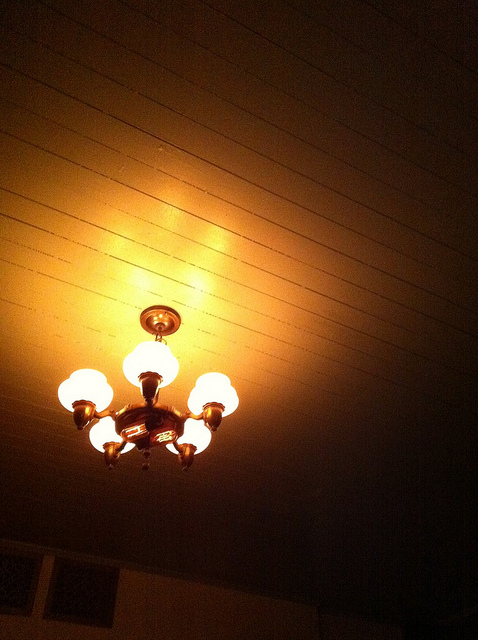
shots around town



all in your mind
Ars Technica: Self-affirming essay boosts coeds’ physics skills
For many years, there has been a persistent achievement gap between the performance of males and females in math and the sciences. It has become increasingly apparent, however, that the problem is cultural. The math gap seems to vanish in countries with higher degrees of gender equality, while females exposed to the stereotypical expectation that they’d do worse in a subject tended to live down to these low expectations. These findings, however, don’t provide clear guidance as to how to address the problem: if females have already been exposed to these stereotypes, how do you get them to ignore them and perform up to their abilities? The answer, it appears, may be as simple as a short essay.
He’s human.

Above is a shot of Steve Jobs at his desk at his home in 2004, from this series by Diane Walker (via Minimal Mac).
I know there’s people of there who imagine billionaires and superstars like Steve Jobs in grand castles of marble and gold who are constantly getting jettisoned between continents in private jets.
They don’t imagine a dude in room with white-painted brick walls at a simple wooden desk with a messy pile of paper and books on it.
Cold + Bold
A great presentation by Jonathan Harris on his work as an artist-programmer and his battle between life and code.
Here’s a piece of a journal entry he wrote shortly after his MoMA show, I Want You To Want Me :
I have to live to work. Thats what Hemingway used to say. His work was to write boldly. So he had to live boldly first to get good material. These days my work is also to write, but to write code, not words. To write good code, it’s often best not to live life and certainly not to live life boldly because living life boldly requires energy and empathy and to write good code you need to save those things for your program and not waste them on people. This kind of strategy makes your code bold, but your life cold.
It’s weird – the more time I spend with computers the more I feel they’re exerting some kind of hold over me. Like it’s me serving them and not the other way around. When I’m deep into my program like I am now I feel like a totally different person than I am on the road. In fact, I frequently don’t feel like a person at all but some organic operating proxy to type the necessary instructions. I lie on my bed in the afternoon and look at the wall and it’s hard to know exactly what I’m feeling because my mind is entirely inside the machine.
via Minimal Mac
Kickstarter: Disrupting With People
Kickstarter is blowing doors on monetization strategies this year and challenging traditional consumer and auction paradigms. News dropped today of Scott Wilson breaking Kickstarter’s funding record by raising over $275,000 for his iPod Nano watch enclosure. And he raised that money in one week. One.
I first learned of Kickstarter from a post by Craig Mod where he broke down how he was able to fund the printing and publishing of his book, Art Space: Tokyo. It’s a must-read for anyone in any type of media who wants to stay relevant.
Forget that. You need to understand the success of Kickstarter of you’re a human being who works in order to obtain money to live. Period.
The hook for me, what makes Kickstarter so powerful is the human element. Call it social networking, call it viral, call it crowdsoucing. I call it human.
The Economist did an interview with one of the founders, Perry Chen. The whole interview is great, but this bit stood out for me:
Just like eBay or Etsy, you are obligated to do what you say you’re going to do–fulfil the limited edition, or create the event or experience that you promised to create–in exchange for someone opening their wallet and backing your project. The interesting thing is that these projects are funded by dozens, hundreds and in some cases thousands of people, but it is never completely anonymous. Within those backers are friends, long-time fans, family members, classmates, people in the gardening club with you. So there’s already a social fabric that’s brought into Kickstarter. The accountability is strengthened because those people are there.
People.
Just keep people in mind when you’re starting a new business plan. If you keep the focus on people and not on “how we’re going to beat the competition”, you’re already putting yourself in a better position for success.
James Pedrazzini
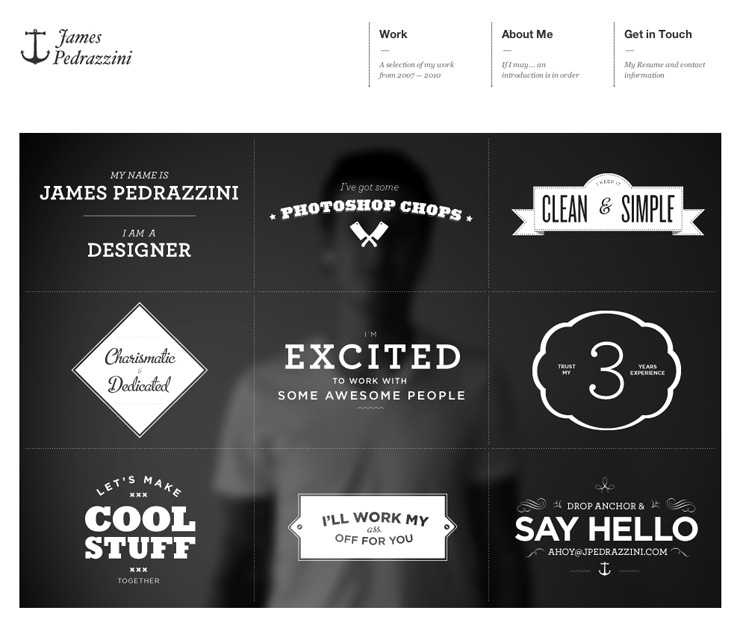
James Pedrazzini (via siteInspire)
same toooo you
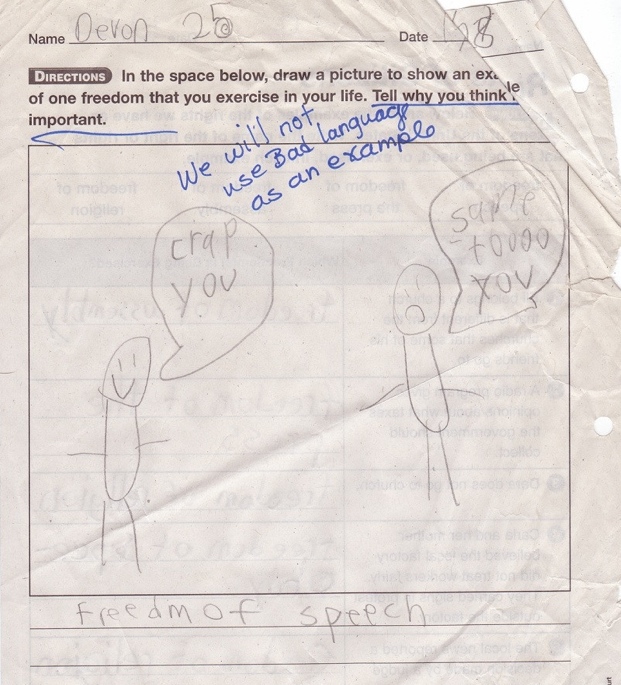
What drives Max Levchin
GigaOM: In His Own Words: Max Levchin
Levchin on what motivates him:
At any given moment what makes me tick is some combination of desperate desire to remain relevant, the make things that people care about, probably some very strong competitive streak, where if I see a friend or a competitor or someone I know making something awesome, I look myself in the mirror and I ask myself ‘why I am I not making that? Or why am I not making something even more awesome?’ … But a lot of times I just want to have fun, so I wake up and try to do fun things.
Hey co-created Paypal and sold it. His most recent company, Slide, was bought by Google for $200 million.
Some people wonder why guys like this keep working.
There’s your answer.
If this isn’t nice, I don’t know what is
In one of his stand-up specials in the 80’s, George Carlin explained his problem with people who say have a nice day. Now all the pressure was on him to try to go out and have a nice day. Having a crappy day was easy, he said. You just get up.
That’s the thing with cynicism – it’s easy. And while the name of this site is Daily Exhaust (exhaust as in venting, getting things off my chest), my goal is not to make this site a huge bitchfest. I have more to contribute than that. I like positive energy. The love you take is equal to the love you make. All that good stuff.
You can find things wrong at 10,000 feet looking at the earth or 10 feet away, looking at your personal life. But that’s easy. It’s harder to keep the chin up.
This bit from Kurt Vonnegut is a great example of the attitude I’m promoting (via Northcoast Zeitgeist):
And now I want to tell you about my late Uncle Alex. He was my father’s kid brother, a childless graduate of Harvard who was an honest life insurance salesman in Indianapolis. He was well-read and wise. And his principal complaint about other human beings was that they so seldom noticed it when they were happy. So when we were drinking lemonade under an apple tree in the summer, say, and talking lazily about this and that, almost buzzing like honeybees, Uncle Alex would suddenly interrupt the agreeable blather to exclaim, If this isn’t nice, I don’t know what is. So I do the same now, and so do my kids and grandkids. And I urge you to please notice when you are happy, and exclaim or murmur or think at some point, If this isn’t nice, I don’t know what is.
Have a nice day. Really.
My Friday Moment of Zen

via Motoriginal
Photoshopping isn’t always a bad thing.
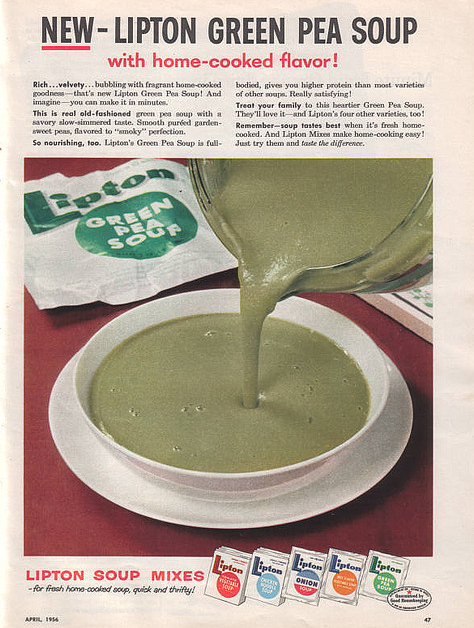
Say what you will about doctored photos being bad and not representing people, places and things as they really are, but I wouldn’t mind a retoucher spending a little time on this Lipton ad.
That’s just foul.
via Found In Mom’s Basement
The Priority Is Content
Content & Advertising.
Those two are usually fighting in the media.
While there’s plenty of examples of corralling each into their own space and co-habitation, Advertising is usually the one doing the bullying. We talk of the need for advertising to move beyond dis/interruption, but I’m not sure that’s possible. At best we can attain a salad dressing-like mixture of oil and vinegar. It might taste good, but look closely and you’ll see they never fully unify.
And I’m fine with that, because there’s 3 tools that put Content back in the drivers seat – Instapaper, Readability and the Reader tool in Safari 4.
It’s interesting these tools exist. It implies readability is not a priority for news and media websites.
advanced tip – many news sites break articles into multiple pages, somewhat crippling the tools below. The solution is to view the Printable version of articles. This *usually shows the article on one, continuous page.
Quick breakdown:
Instapaper
This is an iPhone/iPad application. First set up an account and download the app to your iOS device, then you set up a bookmarket in the bookmarks bar of your computer’s browser. As you come across articles you want to read later, you click on the bookmarket, which places the article into you Instapaper queue. Now, when you launch the Instapaper app, all the articles you ‘Saved for Later’ will get downloaded to your device (provided you have an internet connection). The best part of the app is it downloads just the article and associated images. No banner ads, no navigation, just the content.
Readability
Readability also uses a bookmarket. It’s simple, when you’re on a page you want to read, click on the bookmarket and the page instantly gets stripped of all formatting, leaving you with a clean white page with a single column of easy-to-read text. It also gives you links to: Return to Article, Print and Email.
Safari Reader Tool
This tool works the same as Readability, except it’s baked into the Safari browser. The only catch to this tool is it only shows up in the address field when you’ve reached a page Safari deems eligible, such as individual article and blog post pages. It won’t, for instance, be available to use on the home page of the NYTimes.