Before Hipsters, 1879
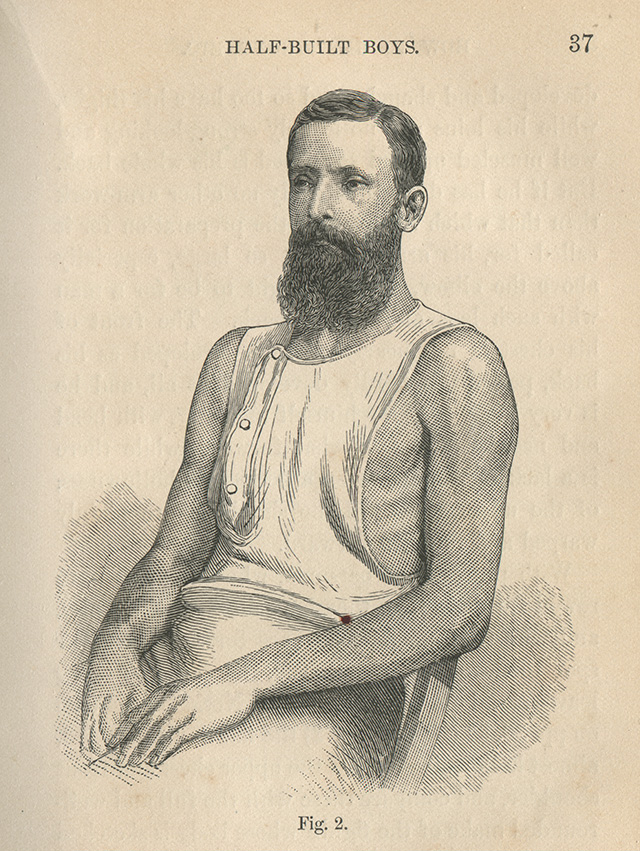
Taken from The Combustion Chamber
Taken from The Combustion Chamber
Some people cover songs by other musicians and others transform the song into something completely new and different, yet also recognizable to the original. Joe Cocker did this with his version of the Beatles’ ‘With a Little Help From My Friends’ he performed at Woodstock in 1969.
When I watch the video of Cocker I can feel the energy he put into it. He discarded the elements of the Beatles original version and supplanted them with pieces of his own identity and emotions. It’s a powerful performance.
Real art is transformation.
News Alert: in the future video cameras will replace mirrors.

Taken from Head Like and Orange
Design Agency Huge did research on scrolling:
We wanted to know how page design impacts these user behaviors and to what extent visual cues help users scroll below the fold.
To find out, we conducted user testing with 48 participants over 3 days. We did so using unmoderated remote testing to see how this less conventional methodology would compare to mediated testing, our usual approach.
Spoiler: Everyone scrolls.
I’ve been designing websites for 15 years and I’m fucking sick of the fucking “fold”.
I can’t want until “the fold” becomes a non-issue and we can stop talking about it.
Instagram makes teens and celebrities angry by killing millions of spambots:
A crackdown on spam Instagram accounts has triggered a cataclysm in the world of low-grade social media celebrities. The event, which began today after the photo-sharing service made good on its promise to start deleting millions of fake accounts, has been dubbed the “Instagram Rapture” after the follower counts of apparently popular Instagrammers were savaged. Rapper Tyga saw his followers drop from 5.5 million to 2.2 million, while Ma$e committed Instagram’s version of seppuku, deleting his account after freefalling from 1.6 million followers to around 100,000.
Where’s the fucking problem?
This week Michael and Bryan discuss dog-sitting, picking up poo, changes in San Francisco, McLaren, the high cost of attending an F1 race, Michael’s horrible first two Lyft rides, basement rock performances with a 12-pack of Modelo, dive bars, movie theatres, the movie Whiplash, discipline in college and alcoholic writers. This episode opens with the exhaust from a modified Studebaker.
Weekly Exhaust – Episode 24 (subscribe on iTunes)

Mike Isaac for The New York TImes:
Regulators in Chicago have approved a plan to create one or more applications that would allow users to hail taxis from any operators in the city, using a smartphone. In New York, a City Council member proposed a similar app on Monday that would let residents “e-hail” any of the 20,000 cabs that circulate in the city on a daily basis.
It is a new tack for officials in the two cities, a reaction to the surging use of hail-a-ride apps like Uber and Lyft.
What a fucking novel idea. When given the opportunity I’ll take Über over traditional taxis (in any city) any day of the week.
Once again, Darwin is more relevant that ever: “It is not the strongest of the species that survives, nor the most intelligent that survives. It is the one that is the most adaptable to change.”
Ed Bott on the dire outlook for Windows Phone:
If the problems with Windows Phone as a platform were as simple as Microsoft getting their product strategy together, it would probably be easy to fix. But that focus ignores the real problem.
This isn’t an equal partnership between Microsoft and U.S. mobile carriers, except perhaps in the most technical sense.
Thanks to Microsoft’s minuscule market share (small single-digit percentages in the U.S.), the carriers have almost no interest in collaborating with it on mobile devices. And Microsoft has almost no leverage when negotiating with carriers. The resulting not-so-virtuous circle is what stacks the deck against the Windows Phone platform and makes the experience so frustrating for the few who actually use it.
Maybe if Microsoft asks Santa for more customers, they’ll get em.
I’ve been using computers since I was 4 years old, so I know a little bit about how to use them and how they work. For instance, there’s times I’ll know when my frozen MacBook Pro will unfreeze, or whether the beachball will continue to spill for infinity. This is not black magic, but based on knowing what processes are running and thinking about what could be clogging up the system.
It’s not just that I troubleshoot computers, but I know how to.
Most people who know me know that I’m good with computers so they ask for my help. What usually happens is this:
Broken Computer Person: Mike, can you figure out why [name of broken thing] won’t work on my computer?
Me: Sure, let me take a look.
[I sit down at the computer, troubleshoot for a few minutes and fix the issue]
Me: There. Should work now.
Broken Computer Person: Holy crap. Awesome! What did you do?
Me: I just did [description of solution].
Broken Computer Person: I JUST did the very same thing, but it didn’t do anything!!! Why did it work for you and not for me?!
If I had a dollar for every time a version of the above has happened to me, I’d uh, have many hundreds of dollars.
I needed a name for this phenomenon, so I enlisted the help of my brother Mark. I explained to him how in quantum mechanics, they have the Heisenberg Uncertainty Principle–where the observer affects the outcome of the experiment.
What I needed was a name for what happens in situations like the above scenario.
A few days later, my brother replied:
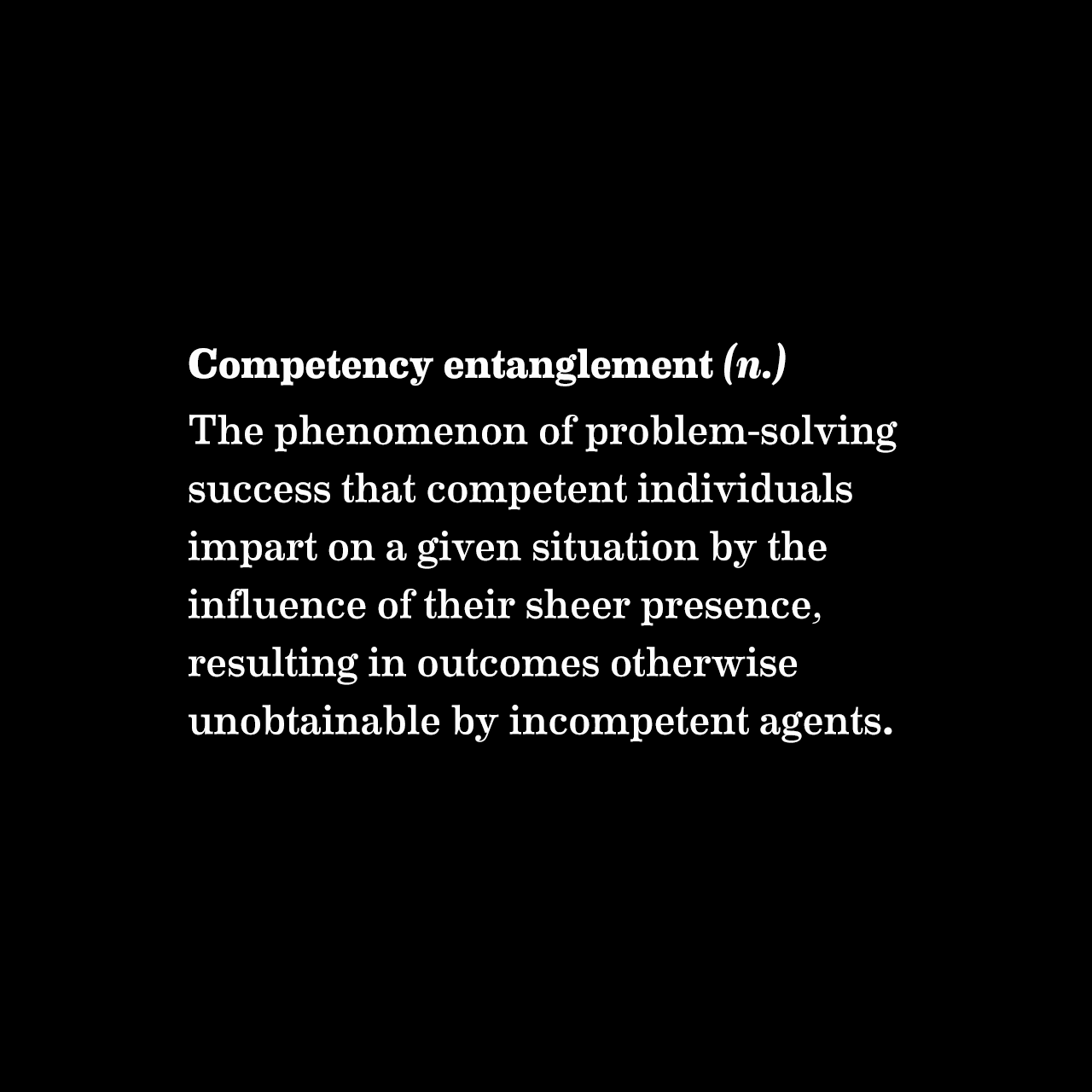
Competency entanglement (n.) The phenomenon of problem-solving success that competent individuals impart on a given situation by the influence of their sheer presence, resulting in outcomes otherwise unobtainable by incompetent agents.
Nice job, Mark. I consider this an early Christmas present.
 —
—