The Noun Project
The Noun Project collects, organizes and adds to the highly recognizable symbols that form the world’s visual language, so we may share them in a fun and meaningful way.
The Noun Project collects, organizes and adds to the highly recognizable symbols that form the world’s visual language, so we may share them in a fun and meaningful way.
Richard Florida on What Makes Nations Thrive:
Our results indicate that the factors that contribute to happiness differ in high- and low-income countries. In low-income nations (defined as those with less than $11,000 in per capita GDP), happiness turns on income. But it matters much less in high-income countries. In these countries, people are affluent enough to cover the basics which are essential to a base level of happiness. Two factors matters in particular over and above income in these more well-off nations. The first is the nature of the job market: people are happier in affluent nations where more of them work in knowledge-based, creative, and professional jobs and fewer work in blue-collar working class jobs. Values matter too, especially openness and tolerance toward ethnic and racial minorities and toward gay and lesbian people.

via The Escapist

The new VW Beetle is no longer cute and iconic. It looks a little bigger, a little uglier and ill-proportioned.
Like a teen going through puberty.

The 1991 Nissan Figaro probably one of the cutest and most well-done retro cars I’ve seen. Too many retro models try too hard.
This guy is just a happy little bastard. I love it!
via Motoriginal
Let me tell you something you already know. The world ain’t all sunshine and rainbows. It’s a very mean and nasty place and I don’t care how tough you are it will beat you to your knees and keep you there permanently if you let it. You, me, or nobody is gonna hit as hard as life. But it ain’t about how hard ya hit. It’s about how hard you can get it and keep moving forward. How much you can take and keep moving forward. That’s how winning is done!
–Rocky, Rocky Balboa
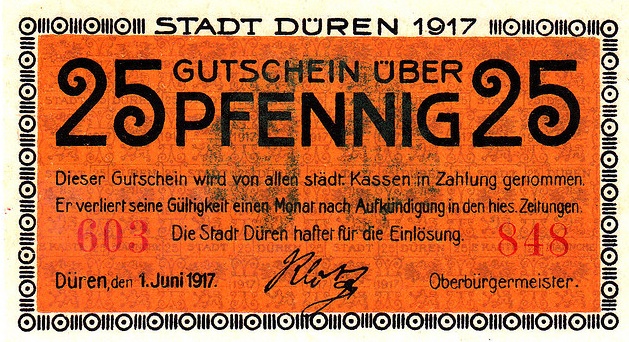
Above is a Notgeld or emergency German currency during the post-WWI inflation period.
More beautiful examples over at Words and Eggs.
The Escapist: Computer Built in Minecraft Has RAM, Performs Division
Last October, I showed you guys a simple CPU that a user named “theinternetftw” created in Minecraft that used torches to ignite redstone wires to add numbers and output that information as binary code. Now, a Minecraft player known as Salaja has created an even more complex machine that is capable of loading 16 lines of code into its RAM, and then performing operations before displaying the results on a screen in hexadecimal notation. In one example video, Salaja loads the “division program” and then successfully divides 9 by 5. The only downfall is that the computation takes a little while for the charge on the redstone to travel, but Salaja’s home-designed computer within a computer game is still quite a mind-boggling feat.
I understand what this guy did on a fundamental level, but trying to fully comprehend this is like trying to fully comprehend infinity or a black hole.
via Missile Test

From the MegaPhone product page:
Passive Amplifier for iphone made of ceramic. the form is designed to amplify and optimize the best sound output. the amplifier is based on a thin wooden frame that allows the object to float off the table. this in order to increase the vibration of the object and to optimize the emission of sound. designed for the iPhone is perfect for listening music without headphones, for audio conference to hear the person on the phone as live voice.
Badass.
via Co.Design






MediaShift: How One Radio Reporter Ditched His Equipment for an iPhone 4
It’s been more than a year since I packed away my laptop computer, digital recorders, microphones, cables and cameras, and began covering Washington, D.C. with only my iPhone.
When I first came to the top-rated all-news WTOP in 1997, the bag phone I carried weighed as much as a bowling ball. Reel-to-reel tape recorders (ask your parents) were the newsroom staple, but early versions of Cool Edit audio editing software signaled that the times, they were a-changin’.
That just happened.
Austin Kleon on How To Steal Like An Artist (And 9 Other Things Nobody Told Me):
There’s an economic theory out there that if you take the incomes of your five closest friends and average them, the resulting number will be pretty close to your own income.
I think the same thing is true of our idea incomes. You’re only going to be as good as the stuff you surround yourself with.
I could have quoted the whole post.
I think I’ll just steal it instead.
via kottke
Some good advice over at significantpixels on designing for the iPhone’s tab bar.
Over the last couple of years, the iPhone has greatly popularized the tab bar navigational model for mobile handsets. Apple has put together a design rationale for the tab bar in their Human Interface Guidelines (HIG) along with lots and lots of other information — they do however leave some question unanswered. Having worked with interaction and graphical design for iPhone applications during the last couple of years I’ve managed to pick up some lessons the hard way, and in this post I would like to share my thoughts on a couple of do’s and don’ts.
Some obvious points in the post, but good advice usually is obvious.