Pebble 2, $12.8 Million

Pebble’s third Kickstarter ends with $12.8M raised, $7.5M less than last year:

Smartwatch maker Pebble wrapped its third Kickstarter campaign today with $12,779,754 in preorders for the company’s upcoming products: the Pebble 2, the Time 2, a little Spotify streaming box, and a refresh to the Time Round line.

Pledges this year fell short of last year’s milestone of more than $20 million, but surpassed the company’s 2012 campaign, when it collected about $10 million.

Let’s start with the obvious: Enthusiasm for new Pebble watches appears to have slipped. Pebble has a history of breaking its own records — as well as Kickstarter’s — and that didn’t happen this year. It took the company a mere 48 hours to surpass $10 million in preorders in February 2015. This time around, it took Pebble more than twice as long.

I wish I had problems like raising 12.8 million dollars.

It’ll be interesting to see what happens to Pebble in the long term with Apple likely debuting a new Watch this fall and Google updating their Android Wear. I wonder if Pebble can hold on to and grow their loyal customer base or if they’ll get squeezed out.


Categories:

Uncategorized

Tags:

Google Wants Everyone’s Milkshake

Ars Technica: Frontier teams with AT&T to block Google Fiber access to utility poles:

AT&T’s lawsuit, filed in US District Court in Western Kentucky, concerns the Louisville Metro Council’s “One Touch Make Ready” ordinance’s effect on AT&T-owned utility poles. This type of ordinance is designed to speed up construction of new networks by making it easier for companies to attach wires to poles.

The Louisville ordinance lets companies like Google Fiber install wires even if AT&T doesn’t respond to requests or rejects requests to attach lines. Companies could also move AT&T wires to make way for their own wires without notifying AT&T, as long as the work wouldn’t cause customer outages. This also limits the number of construction crews needed for pole work, since each provider wouldn’t have to send its own workers to move their equipment.

AT&T, which is building its own fiber network in Louisville, claims that the ordinance lets competitors “seize AT&T’s property.”

It seems if AT&T owns these poles, then they have the right to reject another company adding an additional cable to it. So does this mean if a new company wants to run their own wires through a county/city/state they should be required to construct their own telephone poles? That would get messy.

AT&T used to hold a government-authorized monopoly when they built out the first trans-continental telephone network in the United States in the early 20th century. If it weren’t for this approved monopoly the US wouldn’t have had as reliable a longline network as it does today—if you’ve ever used a “land line”, how many times has it dropped a call on you? The government eventually broke up this monopoly in 1982. Perhaps there shouldn’t be a monopoly around these poles either.

Google’s attitude towards these telephone poles reminds me of how Google used to use public bus stops here in San Francisco for free for their private company shuttles. In 2014 they had to start paying to use them. Maybe they should be required to share their poles with other countries, but charge them a fee for using them. Google can’t expect they can continue to use other people’s shit for free.

Categories:

Law, Technology

Just My Luck

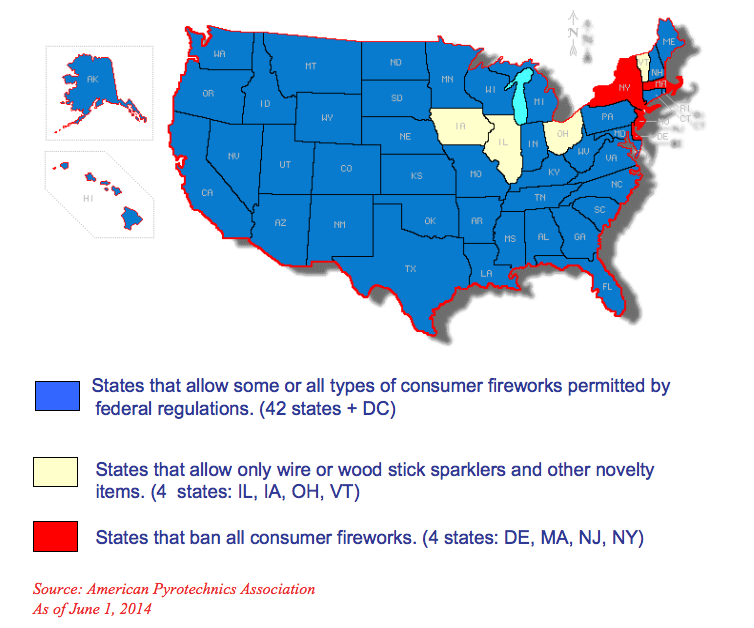
This is a map of the fireworks laws by state:

It’s my luck that I grew up in New Jersey. One of the 3 states that bans them. It was so sad that we actually got excited if someone was able to get a hold of some sparklers. And if someone had bottle rockets? Forget about it. Shit got real.

Categories:

Law

Spotify: “Mom! Apple isn’t playing fairrrrr”

Spotify: Apple is holding up app approval to squash competition:

Like other apps, Spotify had been getting customers to foot the bill for Apple’s App Store billing fees by charging an extra $3 a month. It recently launched a promotion for the second time that gave new users three months of service for a dollar, if they signed up on the web. As you can imagine, that didn’t make Apple too happy, and the company reportedly threatened to pull the app entirely unless Spotify stopped pushing the deal for iPhone owners. It complied with the request, but it also nixed the iTunes billing option in the iOS version which lead to the current dispute.

On one hand, I feel like this ends up hurting happy Spotify and Apple customers. Elizabeth Warren recently accused Apple, Amazon, and Google of anti-competitive practices. This issue with Spotify only adds fuel to the fire.

On the other hand, why should Apple make and exception for Spotify and wave the App Store fee? It seems as though the Google Play store also charges 30% fees like Apple.

Categories:

Business

Halt and Catch Fire, Season 3!

The Verge: Halt and Catch Fire’s third season will premiere on August 23rd:

Halt and Catch Fire, AMC’s consistently entertaining, detail-obsessive ’80s period drama, will return for its third season on August 23rd. The season’s first two episodes will air back-to-back beginning at 9PM ET.

Halt and Catch Fire’s third season will see the show moving from Texas to Silicon Valley for its 10-episode run. Last season, the series largely followed Cameron and Donna’s attempts to get their online games company, Mutiny, off the ground. Although the show sometimes seemed uncomfortable in the startup world, given the first season’s exploration of the slightly stodgier Cardiff Electric, it remained innovative and well-crafted.

This is great news for a great, and underrated show.

I grew up in the early 80s and can attest to how ‘detail-obsessed’ the show is. Many times in shows and movies, when they’re depicting computers, they use interfaces and sounds that don’t exist in real life. In Halt and Catch Fire they’re true to the real world (or pretty close anyway).

And as for where the title comes from:

In computer engineering, Halt and Catch Fire, known by the assembly mnemonic HCF, is an idiom referring to a computer machine code instruction that causes the computer’s central processing unit (CPU) to cease meaningful operation, typically requiring a restart of the computer. It originally referred to a fictitious instruction in IBM System/360 computers, but later computer developers who saw the joke created real versions of this instruction for some machines. In the case of real instructions the implication of this expression is that, whereas in most cases in which a CPU executes an unintended instruction (a bug in the code) the computer may still be able to recover, but in the case of an HCF instruction there is, by definition, no way for the system to recover without a restart.

The expression “catch fire” in this context is normally facetious, rather than literal, referring to a total loss of CPU functionality during the current session.

Not only is the show great, so is the intro:

Elastic is the studio behind the intro (via The Art of the Title).

Oh, and I have a crush on Kerry Bishé:

August 23rd, 9PM. I’m there.

Nate Silver: Clinton Has an Eighty Percent Chance of Winning

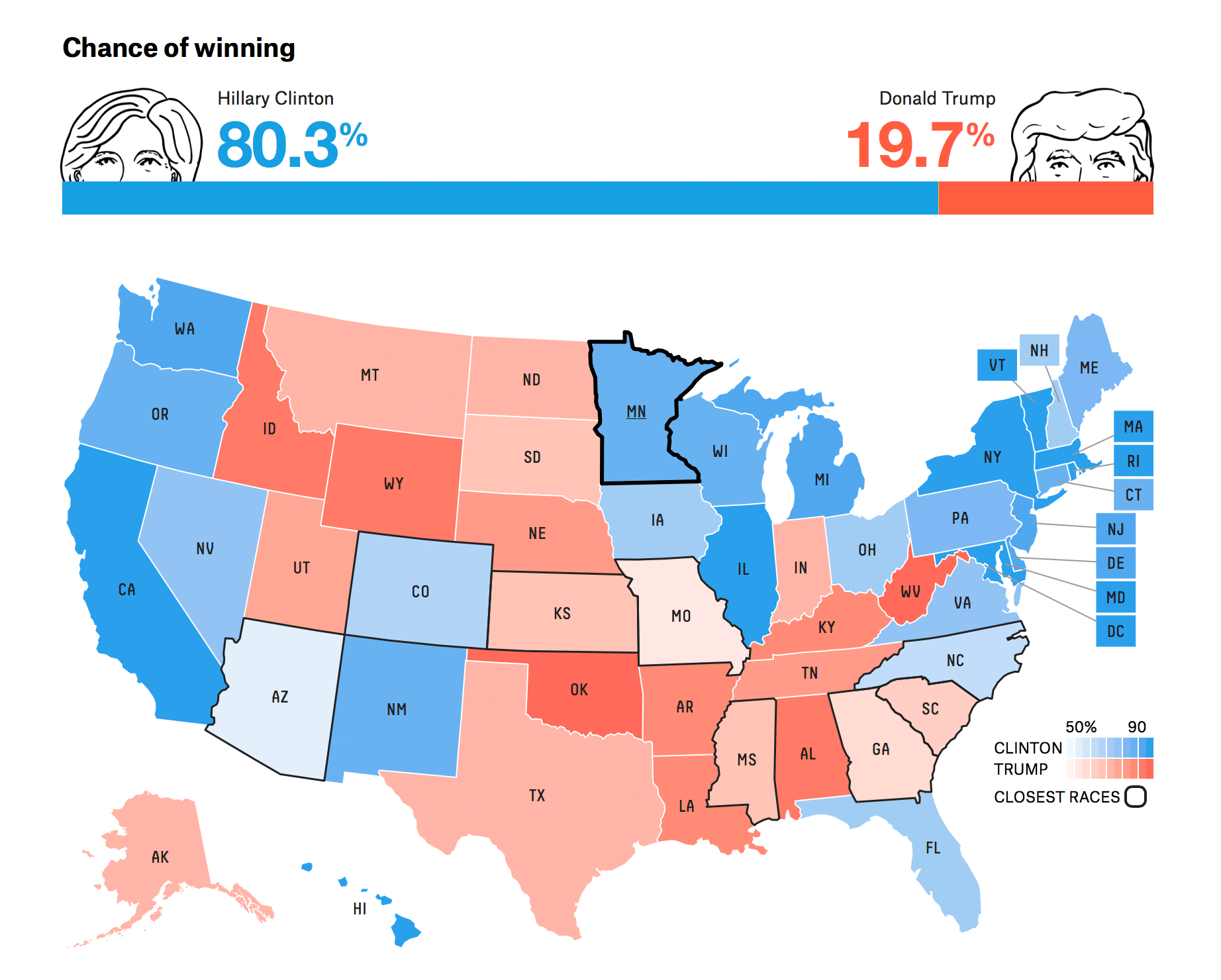
Nate Silver says Hilary Clinton has an 80.3% chance of winning the election.

Obviously, this is a forecast and things could change between now and November 8th, but let’s try and keep it this way.

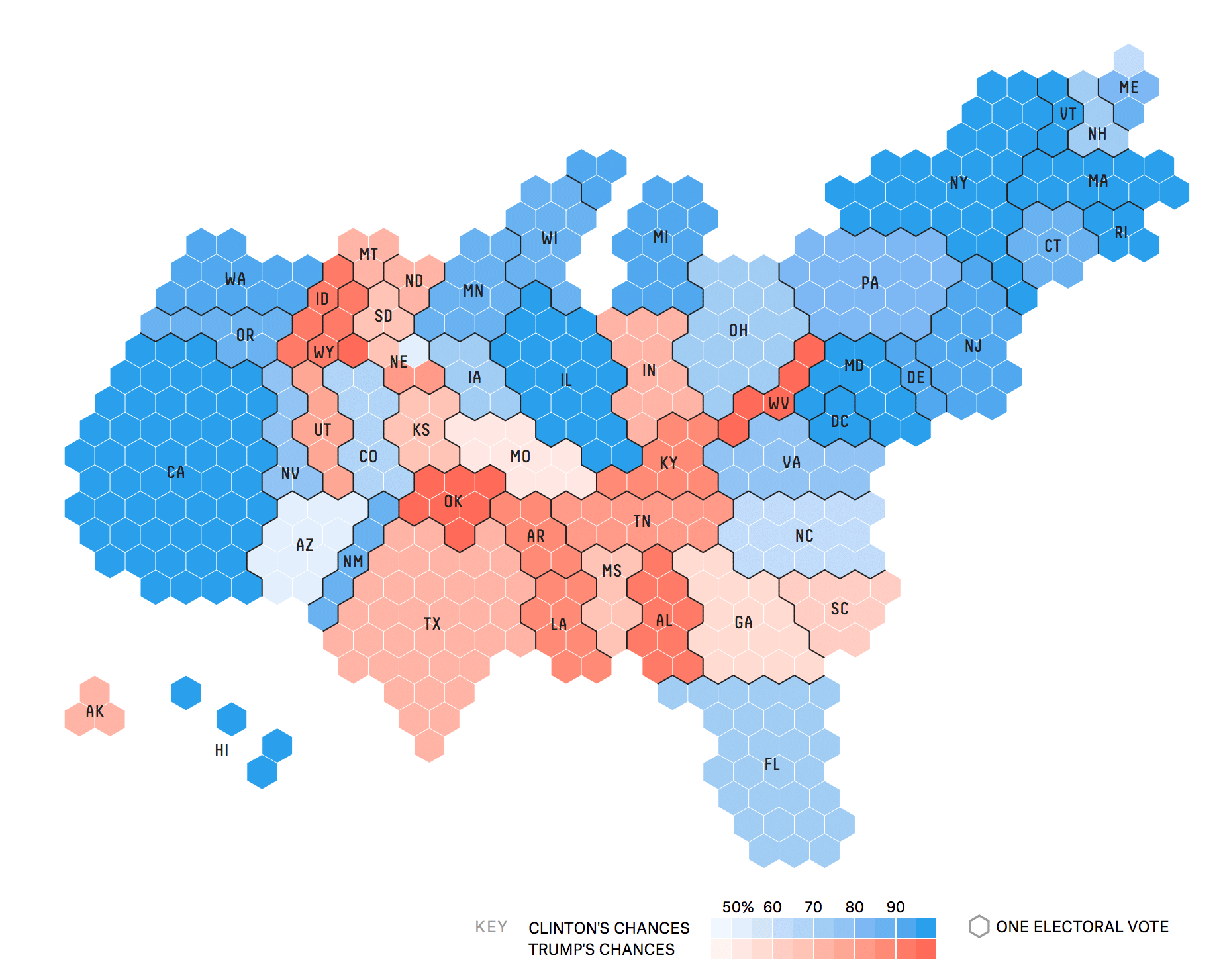
FiveThirtyEight has some great data visualizations.

Here’s one showing, “…a map of the country, with each state sized by its number of electoral votes and shaded by the leading candidate’s chance of winning it.”:

You can agree or disagree with Silver’s predictions, but you can’t say he isn’t thorough.