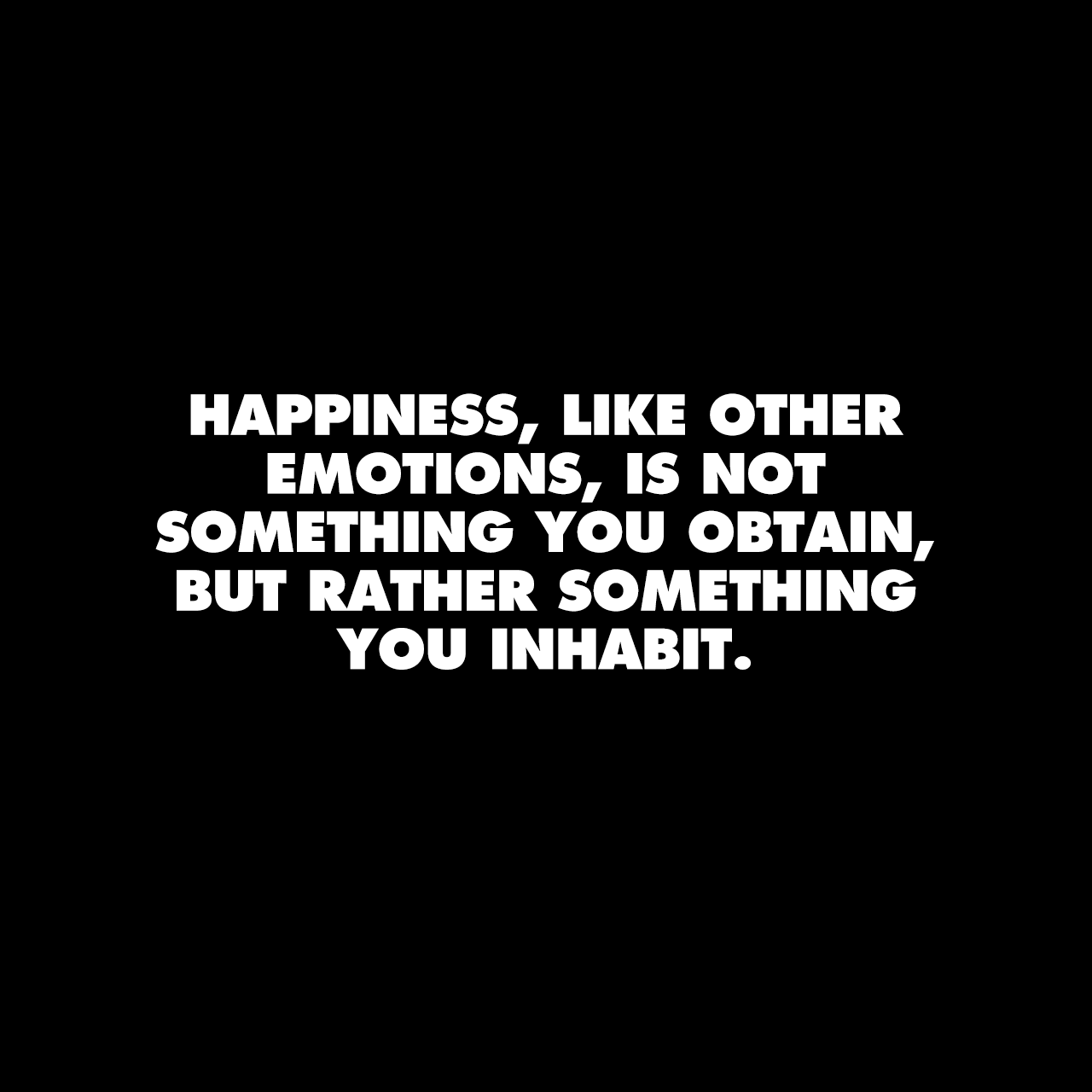
Does Not Include
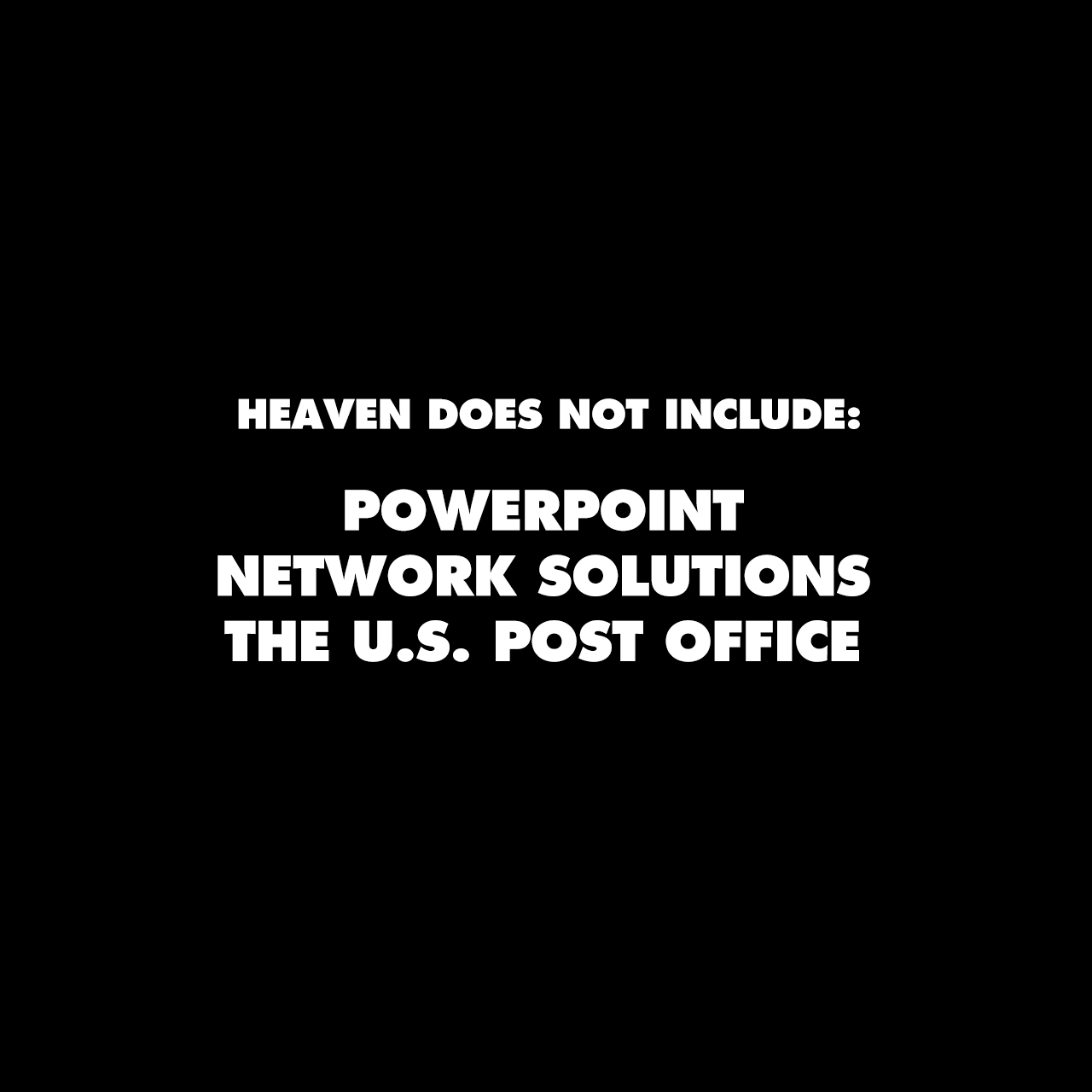
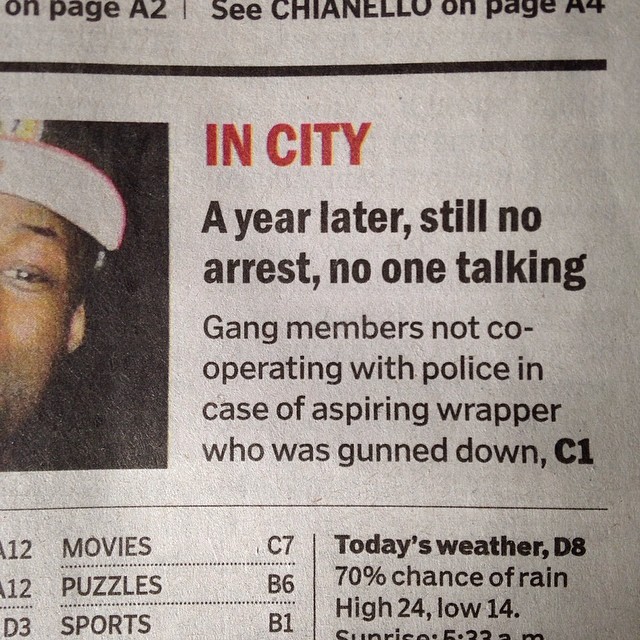
via Instagram
The social media platform is not only launching the career of under-the-radar artists, it is providing the world with an entirely new way to access art. Where artists once had to first get support of the art world elite–critics, galleries and big name collectors, which would eventually lead to museum shows–before reaching the monied masses, today artists use Instagram as their own virtual art gallery, playing both dealer and curator while their fans become critics and collectors, witnessing the creative process in real time.
Vogue
From Steve Lohr at The New York Times:
Gov. Andrew M. Cuomo of New York last month appointed a three-person commission to offer thoughts on the use of technology in schools.
The group, the governor’s office said in a statement, will be “charged with advising the state on how to best invest” the $2 billion the governor plans to raise in a “Smart Schools” bond issue in the fall.
Eric E. Schmidt, executive chairman of Google, is one of the three, but his appointment raised some eyebrows. Mr. Schmidt’s company has a commercial interest in seeing more Chromebook computers, which run Google’s Chrome web software, and the company’s productivity applications, Google Apps, being used in schools.
That’s bullshit.
(I’d feel the same way if Tim Cook was on the commission, only to a much lesser degree because I prefer Apple products to comparable Google ones)
From BGR:
Motorola executive Mark Randall is saying what a lot of other gadget watchers are thinking: The smartwatches we’ve seen released so far are nothing to get excited about. In fact, in an interview with Trusted Reviews, Randall goes so far as to say that every smartwatch that’s been released to date has been “pretty crappy.”
“People just don’t want to wear them,” Randall said of today’s current smartwatches. “We look at the [Moto] 360 and we look at what everyone has done in that space. To be honest we think they are all pretty crappy.”
Smack talk from the company who gave us the RAZR.
Mark Randall best have something off the chain to sell.
Outside of the blogs of technology and design people I follow daily, Quora is one of the most thoughtful places I’ve found on the Web. It’s one of the few places I’ve found where the comments are honest without being snarky or mean-spirited.
I think of the answers to Quora questions as the Bizarro version of Youtube and tech blog comments—they’re not filled with anonymous vitriol.
And it’s not only the quality of the answers I appreciate on Quora but the diversity of topics too.
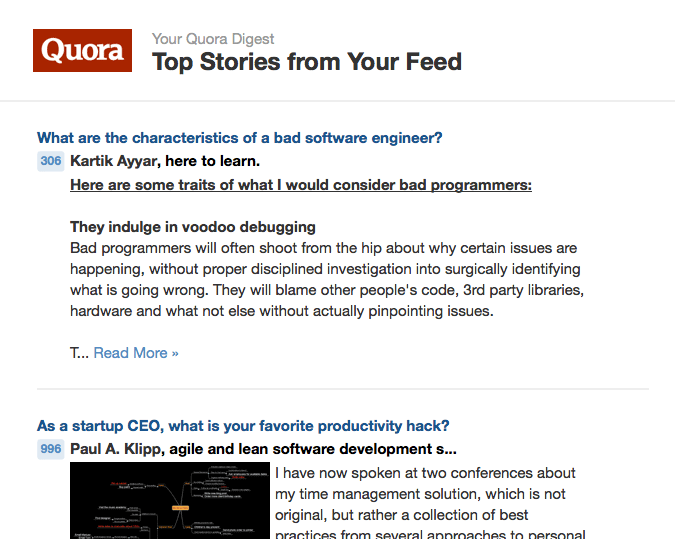

—attributed to George Orwell by Steve Almond in yesterday’s Sunday Times Magazine
Wells Baum on Instagram filters:
I stopped using Instagram filters almost two years ago. You don’t need them. The snap should be able to speak for itself, in its raw untouched nature.
But I do believe that some images still need a little pop. And that’s when you should use the VSCO app, Litely, or Snapseed, whichever apps enable you to adjust the strength of filters without making the photo look fake.
This is partially true. Instagram filters can be heavy-handed. I, like Baum, have not used them in a while. I exclusively retouch photos in the VSCOcam app on my iPhone. Like Instagram, it has preset filters. Unlike Instagram, it let’s you decide how much of a filter you want to use (on a 0-10 slider).
There are many philosophies on photography and many different industries in which photography is used, but there’s many professional photographers who don’t let their photographs leave the studio until they’ve been retouched. Annie Liebovitz used to work with one of the masters of retouching—Pascal Dangin—often referred to as the ‘Photo Whisperer’ (It looks as though Liebovitz now works with Alexander Verhave).
Even before the days of Photoshop, photographers like Richard Avedon were obsessive about tweaking their photos (through the old school process of burning-and-dodging).
Here’s one of his marked up photos:
The fact that #nofilter is one of the most popular hashtags on Instagram means shit to me and has no correlation to how good a photograph is (because most people are bad photographers).
Sometimes I get out of bed and I look fucking amazing, but more often than not, I need to brush my hair and put on a nice, clean, matching outfit. Photographs are no different. In the absence of the time and means to retouch my iPhone photos in Photoshop on my Powerbook, I use the VSCO app to tighten up my images.
Sure, sometimes the light is right, your timing is perfect and you don’t need to monkey with your shot but most photographs can be improved. The key to retouching photos is if someone looks at your photograph and their first thought is, “That’s a great photograph.” NOT, “Oh, he used the Mayfair filter.”
Photo filters bring to mind a quote a friend from design school told me:
“Helvetica is like a good screwdriver; a reliable, efficient, easy-to-use tool. But put in the wrong hands & it’s potentially lethal.”
—T. Geismar
You can find me here on Instagram.
From Wikipedia:
Kintsugi (金継ぎ?) (Japanese: golden joinery) or Kintsukuroi (金繕い?) (Japanese: golden repair) is the Japanese art of fixing broken pottery with lacquer resin dusted or mixed with powdered gold, silver, or platinum a method similar to the maki-e technique. As a philosophy it speaks to breakage and repair becoming part of the history of an object, rather than something to disguise.
What an amazing philosophy.
via Colossal
Matt Richtel, for The New York Times, on introducing coding into the school curriculum:
But the momentum for early coding comes with caveats, too. It is not clear that teaching basic computer science in grade school will beget future jobs or foster broader creativity and logical thinking, as some champions of the movement are projecting. And particularly for younger children, Dr. Soloway said, the activity is more like a video game — better than simulated gunplay, but not likely to impart actual programming skills.
Oh I see, we’re not sure if teaching computer science will beget jobs and foster creativity, but we’re fine cutting funding to the arts in public schools in the United States.
Having an understanding of computer science and coding in no way guarantees you a job, but if I had a choice, you’d be damn sure my kid would know how to code.
We’re beginning to label computers as our enemies more and more, as they continue to prove themselves more efficient and better at our jobs than us. I think the gospel of Vito Corleone makes the most sense: keep them closer.
Great advice from Kickstarter project creators.
Shaunacy Ferro at Co.Design:
The industrial designer of the future might just be a computer. The traditional design process can be a laborious one, full of iterations and tweaks to make a product just so. For years, design software maker Autodesk has been working on an alternative: a program that sorts through all the ways to make a product of specific measurements and then spits out the best option.
I’ve used computers since I was 4-years-old so saying this article frustrates me makes me sound hypocritical. I’m ok with that. But it does.
Our view of how good or bad things are in life is all about degree. It’s not nice to punch a random person in the face, but punching 40 people in the face randomly is worse. It might be enough to land you two minutes on the local evening news.
Similarly, having computers make our lives easier is great, until they start making our lives too easy and take over too many tasks. It’s too late to try and fight this; it’s only a matter of time before we end up like the fat, idle humans in Wall-E.
I made a poster series a few years ago inspired by the Steve Jobs quote, “The computer is like a bicycle for our minds.”
At some point the computers aren’t going to need our minds. They’ll be able to ride their own bikes.
[Also on Daily Exhaust: We Ain’t See Nothing Yet, Manpower Demand, We Are Redundant, I don’t see designers on there… yet.]
From The Verge: The inventor of iMessage leaves Apple for a messaging startup
I hate that term, “inventor”. I hate it because it’s not accurate. I’ve talked about this before in regards to the “father(s)” of the iPod—Tony Fadell, Jony Ive, Steve Jobs or Jon Rubinstein. Take your pick.
If we dig into the article a bit (ok, if we read the first 2 sentences) we get more details:
Andrew Vyrros, the man who led development on iMessage and FaceTime while at Apple, has left the company for messaging startup Layer. The company announced the news yesterday, but Vyrros left Apple several months ago, sources tell The Verge, where he was also responsible for Apple’s push notification services, iTunes Genius, Game Center, and Back To My Mac.
So he’s a lead developer, or likely a director of development. This helps.
Now if we had been reading about the designer “in charge of” the design of iMessage leaving Apple, we would have likely seen a very similar headline as this one.
Design is almost always a collaborative process, so awarding a single person as an inventor of a product is inaccurate.