Copying Chucks

An investigation by the ITC found that a total of 36 Ralph Lauren shoe styles infringed on Converse’s trademarks, including washed canvas, Western leather, camouflage shoes, and bleached denim shoes. Within 30 days of the agreement going into effect, Ralph Lauren have to get rid of these, as well as component parts, tools and molds, advertising, promotional materials and packaging related to the offending products. Ralph Lauren will also pay a monetary sum to Converse, but the amount was not specified in the public version of the settlement agreement. The brand’s main concern is putting an end to impostor Chucks.

Trademark infringement accusations can be difficult to prove in the world of fashion, as the New York Times pointed out: companies must prove that consumers associate a given design with a specific brand, and that the design is not just a part of a larger fashion trend. Companies also can’t legally trademark the functional aspects of their designs. But Chuck Taylors are apparently so clearly Converse-specific that even Ralph’s copycatting can’t cut it.

Co.Design: Ralph Lauren Forced To Destroy Its Converse Ripoffs

Categories:

Clothing

Tags:

Last Wednesday I watched Chappelle’s creative process on stage in Oakland

This past Wednesday night my wife and I went to see Dave Chappelle do standup at Yoshi’s in Oakland.
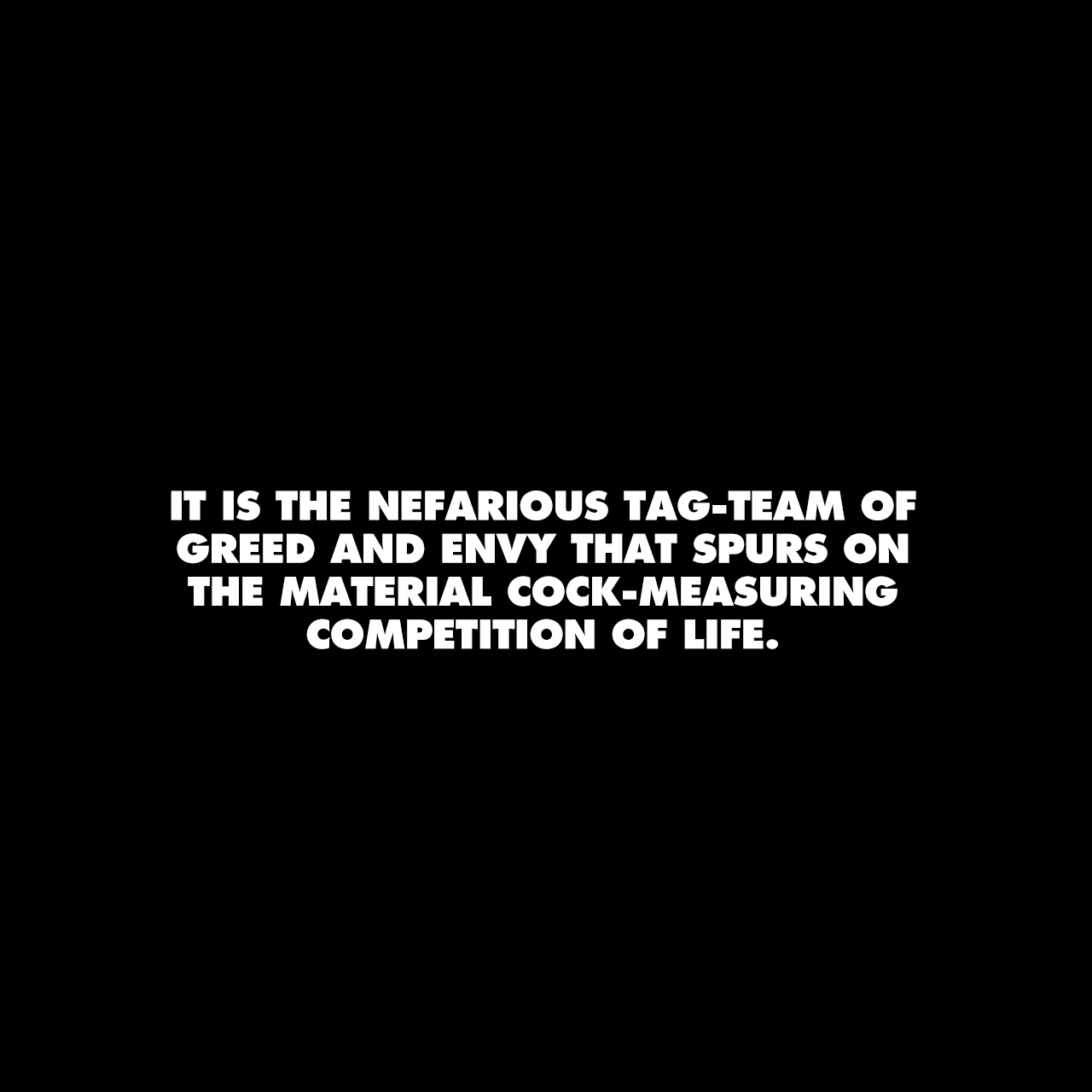

Tickets only became available two weeks ago, and as soon as I bought my two, I realized I should have bought more, but in the 5 minutes that had elapsed they had sold out.

It wasn’t Chappelle’s best performance, but it was still awesome and I still laughed a lot. This is the best part about true “professionals” in any trade: seeing a pro on a bad day is still 10 times better than seeing someone with mediocre talent on a great day.

No, Chappelle wasn’t slaying us with razor sharp jokes (no doubt some of them were sharp). This was a Chappelle figuring out a new act, testing out new jokes, swimming into uncharted territory where he might or might not be greeted with a hearty laugh. I was witnessing the comedic process. Yes, comedy has a process exactly like the processes found in music, writing, sports and graphic design.

At one point he straight up admitted some of his jokes were half-baked (no pun intended). One of his bits talked about how the next group of people he felt bad about besides black people was fat, black people. He gave examples like Michael Brown and Eric Garner. Yeah, Chappelle has some fucked up thoughts in his head and he’s not afraid of talking about sensitive issues. At the end of his act he revisited the fat black people bit and said (I’m paraphrasing), “Look, I know this fat, black people thing isn’t working great right now, but in a few months it’s going to be fucking comedy gold! Trust me!”

Seeing Chappelle having the courage to test out jokes he’s never done (or only done a few times) is a great lesson to to everyone who makes things. You need to create that first draft of your book, or first take of your song, or first design comp for your website before you can improve on it, refine it, hone it.

You have to embrace the process.

Perfect art doesn’t pop out of your head fully-formed.

Categories:

Process

Tags:

Tribalism & False Dichotomies

Lukas Mathias:

Once you have two groups of people, each advocating for its own position and reinforcing its own beliefs, people seem to start turning off parts of their brains. Things get emotional. Assumptions turn into unquestioned facts. At this point, people are no longer looking for solutions, or for common ground. They’re fighting an adversary.

Tribalism based on superficial, insignificant criteria — the computers or phones we use, the sports teams we like, the clothes we wear, the car brands we drive — is pretty common human behavior, and we fall into it easily.

But if you take a step back, you’ll notice that the whole discussion between these two groups is now based on a fallacious assumption. People have replaced the actual question they’re trying to answer — «how should this UI look and work?» — with a different, misguided question: «which of these two options should we pick?1″

This is a false dichotomy.

I’ll be bringing this thinking to my next critique.

Categories:

Human Experience

Tags:

Understanding Apple Watch

Rene Richie has some great insights on Apple Watch.

First the problem with ‘day-of’ reaction pieces:

Demo areas aren’t real life. The product you’re experiencing isn’t yours. It isn’t connected to your accounts, it doesn’t have your data, and it isn’t set up to your personal tastes. You’re also surrounded by people and noise, you have limited time, and you want to try out as many features as you can. It’s tough to keep the context in mind, to set your expectations accordingly, and to try and extrapolate a product’s demo to its real-life usage. It’s what leads to day-of reaction stories that are sometimes very different to week-in review pieces to months-in review pieces.

And on how Apple Watch fits into the hierarchy of devices (Mac > iPhone > Watch): Notifications and, to some extent Siri, not icons, are going to be the primary portal to apps and activities.

If deeper, longer-form interaction is needed, you’ll absolutely still be able to do it. You’ll be able to tap and spin and swipe and otherwise move through glances and apps and do almost anything you want to do. You’ll even be able to use handoff to continue an especially deep or time-consuming activity on your iPhone, the same way you can handoff from your iPhone to your Mac today.

That’s the advantage of Apple staging convenience and complexity. You can do more with an iPhone than ever before, but you still can’t do everything you can do on Mac, and some things you certainly can’t do as efficiently. You can do a lot of very important things, however, and do them even more conveniently. And that means you don’t have to go running back to your Mac as much as once did.

With the Apple Watch you’ll also be able to do a lot, but not everything you can do with the iPhone. You’ll be able to do some very important things, however, and even some unique things, even more conveniently. And that’ll mean you won’t have to go reaching for your iPhone as much as you do now.

The iPhone is a finer-grained convenience than the Mac/MacBook (for certain things) and the Watch is a finer-grained convenience than the iPhone (for certain things).

Categories:

Technology

Tags:

*

AGENT: We got you into a few emoticons.

ASTERISK: Even Semi-Colon is eating our lunch in the emoticon space. If I see one more winking smile…

AGENT: Yeah, but Go the F**k to Sleep bought you a cottage in Montauk.

—McSweeney’s: The Asterisk Kvetches to Its Agent

Categories:

Words

Tags:

Laurel Canyon

When I first came out to L.A. [in 1968], my friend Joel Bernstein found an old book in a flea market that said, ‘Ask anyone in America where the craziest people live and they’ll tell you California. Ask anyone in California where the craziest people live and they’ll say Los Angeles. Ask anyone in Los Angeles where the craziest people live and they’ll tell you Hollywood. Ask anyone in Hollywood where the craziest people live and they’ll say Laurel Canyon. And ask anyone in Laurel Canyon where the craziest people live and they’ll say Lookout Mountain.’ So I bought a house on Lookout Mountain.

—Joni Mitchell

via The Selvedge Yard

Categories:

Photography

Tags:

Sell More Ads, Don

The Gothamist says data provided to them by Trulia determined Don Draper couldn’t afford his Manhattan apartment in 2015:

  • With Don’s title as Creative Director and Junior Partner it is estimated that he made around $45,000 in the 1960s
  • In 2015, that has a buying power of $355,297
  • Median home values in New York in the ’60s were $75,000, which is pretty good if he was making $45k a year
  • Today, a Creative Director in New York City makes an average of $154,838+ a year [ed. note: Don was also a founding partner]
  • Today, places in Don and Megan’s Park Ave. apartment are going for a cool $16.5 Million

There are lots of fun nit-pickers in the comments too.

Categories:

Finance

Tags:

We Can’t Be Trusted

Elon Musk: cars you can drive will eventually be outlawed:

Tesla co-founder and CEO Elon Musk believes that cars you can control will eventually be outlawed in favor of ones that are controlled by robots. The simple explanation: Musk believes computers will do a much better job than us to the point where, statistically, humans would be a liability on roadways.

“I don’t think we have to worry about autonomous cars, because that’s sort of like a narrow form of AI,” Musk told NVidia co-founder and CEO Jen-Hsun Huang at the technology company’s annual developers conference today. “It would be like an elevator. They used to have elevator operators, and then we developed some simple circuitry to have elevators just automatically come to the floor that you’re at … the car is going to be just like that.” So what happens when we get there? Musk said that the obvious move is to outlaw driving cars. “It’s too dangerous,” Musk said. “You can’t have a person driving a two-ton death machine.”

Bryan and I have talked about this more than once on the Weekly Exhaust podcast.

We humans are fucking idiots, driven by emotion and occasionally use our higher brains to achieve amazing things in areas like science, literature, and healthcare.

I’ll tell you a few things a self-driving car won’t do:

  • text his friend while driving
  • drive after drinking 7 Coronas
  • drive angry after a blowout fight with her boyfriend

I look forward to the day manual cars are leisure vehicles we enjoy on the weekends and not something we have to endure on the highway 2 hours a day to go to and from work.

Categories:

Vehicle

Tags:

Machining Porn

If you’re into manufacturing and machining porn, Greg Koenig has some details descriptions of the processes behind making the Apple Watch:

Apple is the world’s foremost manufacturer of goods. At one time, this statement had to be caged and qualified with modifiers such as “consumer goods” or “electronic goods,” but last quarter, Apple shipped a Boeing 787’s weight worth of iPhones every 24 hours. When we add the rest of the product line to the mix, it becomes clear that Apple’s supply chain is one of the largest scale production organizations in the world.

While Boeing is happy to provide tours of their Everett, WA facility, Apple continues to operate with Willy Wonka levels of secrecy. In the manufacturing world, we hear rumors of entire German CNC mill factories being built to supply Apple exclusively, or even occasionally hear that one of our supplier’s process experts has been “disappeared” to move to Cupertino or Shenzhen. While we all are massively impressed with the scale of Apple’s operations, there is constant intrigue as to exactly how they pull it all off with the level of fit, finish and precision obvious to anyone who has examined their hardware.

It’s attention like this which gives Apple the ability to charge a premium for their products.

Again, something I don’t thing Samsung as a company can do (or cares about).

Categories:

Process

Tags:

rise from a liquid media

News flash, there’s more than one way to skin a cat, and 3-D print objects:

The technology, called CLIP — for Continuous Liquid Interface Production — manipulates light and oxygen to fuse objects in liquid media, creating the first 3-D printing process that uses tunable photochemistry instead of the layer-by-layer approach that has defined the technology for decades. It works by projecting beams of light through an oxygen-permeable window into a liquid resin. Working in tandem, light and oxygen control the solidification of the resin, creating commercially viable objects that can have feature sizes below 20 microns, or less than one-quarter of the width of a piece of paper.

“By rethinking the whole approach to 3-D printing, and the chemistry and physics behind the process, we have developed a new technology that can create parts radically faster than traditional technologies by essentially ‘growing’ them in a pool of liquid,” said DeSimone, who was scheduled to reveal the technology at a TED talk on March 16 in the opening session of the conference in Vancouver, British Columbia. Here’s the video:

via DrewBot

Categories:

Innovation

Tags:

without adding complexity

Kevin C. Tofel on the nut Apple has to crack with their Watch:

The Apple Watch offers most – but not all – of the features I have with my Sony and arguably, has a more elegant interface. Apple’s big advantage here is complete control of both the hardware and software experience; particularly with how well the watch integrates with a connected iPhone. At its core, however, it does most of the same things your phone already can do; just like an Android Wear watch or a Pebble. The watch brings a convenience factor though. Presumably, you can spend less time on your phone because certain glanceable information is available on your wrist.

There’s one commonality with all of these devices however and has to do with the challenge of bringing simplicity and value to the wrist without adding complexity. If an activity takes too long to do on a watch, for example, or requires too much engagement, you’re likely better off just pulling out your phone for a better, faster interaction.

I’m really interested to see how Apple Watch changes the dynamic between me and my iPhone.

Categories:

Human Experience

Tags: