Royalties

Given the surge of multimillion-dollar auction records boasted by Christie’s and Sotheby’s on an almost monthly basis, how do the auction houses justify lobbying against a bill that might pay artists for their works? When Art F City asked a Christie’s spokeswoman, she insinuated that successful artists simply don’t need more money: “European studies have shown that resale royalty schemes provide support to less than 5% of working artists, and the artists receiving royalties tend to be those commanding the highest prices on the primary market.”

Sure, for most artists, large secondary markets are a best case scenario. But only a multibillion-dollar-a-year industry would force us to re-examine a kindergartener’s understanding of ethics. Whether artists are successful or unsuccessful, making millions or pennies, they deserve to share in the money their work generates. “The A.R.T. Act won’t benefit every artist, unfortunately, but this is not an anti-poverty program,” Rep. Jerrold Nadler (D-N.Y.), sponsor of the failed 2011 Equity for Visual Artists Act, told me over the phone. “This is a fairness and equity program. Just because we can’t bring in everybody doesn’t mean we should bring in nobody.”
—Whitney Kimball, Shouldn’t Artists Benefit When Their Paintings Auction for Millions?


Categories:

Art

Tags:

The Post-Scarcity Economy

I just finished reading a great essay by Rick Webb on the post-scarcity economy of the future.
What happens when capitalism is so efficient that us humans are no longer needed to keep the money machine running?
Webb digs in:

The key here, to me, is to start thinking about how economics would work when we decouple labor from reward. Does that make a system inherently communist? I don’t think it does. People work. They get paid. It is market driven, and not centrally planned. In reality,the market already basically dictates this, for who can claim that a Wall Street banker works more than a teacher? The only thing we really need to do is take this to a logical extreme: that people can still get paid doing zero work. This fear seems to be at the heart of most people who say that Europe is communist: if we give people so much welfare, some of them might stop working! Quelle Horreur!

It seems to me that with the rise of machines and robotics, advances in mining technology, energy technology (both fracking and green energy technologies), the obesity epidemic in the US, etc., that there are plenty of reasons to believe that we may be at the beginnings of a post scarcity economy. We have a surplus, no doubt. Of course, we still have legions of people in the world that are starving, and even people still here at home. But we actually have the capacity to feed them, to feed everyone, even now, even if we don’t have the will. It’s not a matter of scarcity; it’s a matter of the organization of labor and capital.
I lost some interest in the middle during all the Star Trek talk, but if all you read are the first and last sections of his essay, you’ll be good (I read through all 20 minutes of it).
As my fellow Exhauster Bryan noted, this is the kind of thing that makes the GOP shit their pants.

Categories:

Finance

Tags:

divided

fellow_americans_bl.png
—Me, I said this. Maybe it’s time the Supreme Court rethought handing down its decisions a week before we’re supposed to be celebrating as one nation.

Categories:

Law

Tags:

Observer of Bad Design

The redesign of Design Observer is truly a missed opportunity.
As with anything design-related, the problems are all in little details.
Here’s a list of problems that caught my eye (top to bottom, left to right):
– Is the black tray at the top necessary for 2 measly links? Seems a bit much.
– The scrolling news marquee at the top is abruptly cropped about halfway across the width the the site, why?
– Sometimes ads are necessary, but does MailChimp have to take up that much room at the top? Christ.
– The lefthand navigation. What is that, 6-point type? Again, why?
– Rolling over blog posts on the homepage reveals a blog post summary. No animation, just a jerky jump-out.
– Why are the ‘Creative Opportunities’ in white text against a light grey background? I can read them, but it’s approaching the edge of readability.
– Because the header is over 250 pixels tall, the scrollable area for the mere three articles is extremely small.
– Even though the website is over 1,000 pixels wide, it feels extremely stuffy and cramped because of all the poor design decisions made. The stacked logo feels cramped, the lefthand navigation feels cramped, the height of the header makes everything below it feel cramped.
– Most disappointing is the lack of sophistication to the typography
I could go on and critique the rest of the site, but you get the idea.
Clearly Design Observer is comprised of some heavyweights in the world of graphic design but traditional graphic design is very different than web design.
It reminds me of when Michael Jordan tried his hand at minor league baseball. Sure, he did ok, but it was anything close to his achievements in basketball.

Categories:

Art Direction

Tags:

There’s No Such Thing As ‘Authentically Digital Design’

The Verge takes a look into the thinking behind the ‘material’ design philosophy for Android:

What is software made of?

The answer came from a design exploration, when Jon Wiley, principal designer for search, and his colleague Nicholas Jitkoff were looking at the now-ubiquitous cards that Google started using in Google Now. They looked at those sliding cards and wondered: when you swiped one away, what was underneath?

“It sounds like such an innocent question,” Duarte says, “and yet it was such a powerful spark.” It led the team to come up with a new way of thinking about the software elements we use and (virtually) touch every day. Instead of just talking about pixels on a screen or abstract layers, the team imagined that these cards and the surfaces they slid around on were actually real, tangible objects.
Software imitating tangible objects. This doesn’t sound like “authentically” digital design does it?
Or does it?
I thought Microsoft was leading the way into the future of software design with Windows Phone and their flat approach. Right? Right?
The answer is: it doesn’t fucking matter. Oh and if anyone tries to use the term “authentically digital design”, punch them in the face and explain to them that term does not exist. Also, to be clear—flat design is not a philosophy, it’s an aesthetic. Like the decision to wear Italian leather dress shoes every day or Chucks (disclosure: I wear Chucks every day).
The answer to Google’s sharp work for their Material Design is that it is both authentically digital AND skeuomorphic. Heresy! Oh no he dih-ent!
Operating systems, mobile applications, ATM screens and every other piece of software with a user interface was made so that human beings could interact with them. Computers, on the other hand, operate using zeros and ones. Everything else we humans build on top of those zeros and ones is made for us to communicate with them.
Software and user interfaces can be neither authentically or inauthentically digital. Software either well-designed or poorly designed.

Categories:

Human Experience

Tags:

Peace Out, Windows Phone.

The latest Kantar Worldpanel numbers for smartphone market share may not be surprising, but they are grim indeed for Microsoft. In the heart of the Windows empire in the United States, Windows Phone’s market share dropped from 4.7% to 3.6% between May 2013 and May 2014. In Germany, the decline was from 6.2% to 5.9%. In Brazil, the share remained flat at 5.5%. In China, Windows Phone saw a collapse from 3% to o.6%.
—Tero Kuittinen, Windows Phone market share: Crash and burn

Categories:

Technology

Tags:

Creativity

[…] Although many people continue to equate intelligence with genius, a crucial conclusion from Terman’s study is that having a high IQ is not equivalent to being highly creative. Subsequent studies by other researchers have reinforced Terman’s conclusions, leading to what’s known as the threshold theory, which holds that above a certain level, intelligence doesn’t have much effect on creativity: most creative people are pretty smart, but they don’t have to be that smart, at least as measured by conventional intelligence tests. An IQ of 120, indicating that someone is very smart but not exceptionally so, is generally considered sufficient for creative genius.
—Nancy Andreasen, Secrets of the Creative Brain

Categories:

Pyschology

Tags:

Adventures in Journalism

francehuff_bl.jpg
Umm, no. The score was 2-0. Huffpost showing, once again, that being first with a story does not always mean being the best. Slow down. Chew your food.

Categories:

Journalism

Tags:

A Surface Mini Couldn’t Replace Anything

Citing its usual anonymous supply chain sources, Digitimes on Monday reported that Microsoft called off its plan to mass-produce and launch the Surface Mini tablet back in May. According to the report, the decision to cancel the device was made because the tablet lacked differentiation compared to other small tablets, and also because the company received “negative responses” from its various brand vendor partners.
—Zach Epstein, BGR
The whole sales pitch for the Surface (Pro) is the fact that it’s a laptop replacement. Microsoft has even gone so far as to offer people $650 to trade in their MacBook Air.
Considering the uphill battle they’re facing trying to convince people their Surface is superior to a MacBook Air experience, imagine them trying to sell a Surface Mini. There’s no way you’re going to convince anyone a tablet with an 8-inch screen is going to replace a MacBook Air.
The only thing a Surface Mini could possibly replace is a Zune.
Don’t even try to tell me you’ve forgotten about the Zune already.

Categories:

Technology

Tags:

Giving Apple a head start by beating them to market.

While it’s impressive how small today’s computers can get, Google and its partners have still failed to demonstrate truly compelling use cases–let alone “rich user experiences”–that will create a mass market for $200+ smartwatches. In almost every example during Singleton’s presentation, simply accessing a smartphone–an activity Google says its one billion Android users already do an average of 125 times a day–seems like it would be a more capable and comfortable solution. (And there’s no either/or option here–today’s smartwatches must be paired to a phone in the vicinity to access the internet.)
— Dan Frommer, Quartz
Seeing all these companies scramble to come up with compelling smartwatches makes me think how much the people at Apple are enjoying watching it all go down. Apple wasn’t first to market with their MP3 player (iPod), smartphone (iPhone) or tablet (iPad).
In the past there was never as much of a desire to preempt an Apple product launch like there is now with the rumored ‘iWatch’. Samsung, and Motorola and LG and Google have all raced to get wearables to market. I wouldn’t be surprised if Apple looked forward to such preempting.
Ironically, this preempting gives Apple a head start in getting things right with wearable computers where everyone else is getting things wrong.

Categories:

Product

Tags:

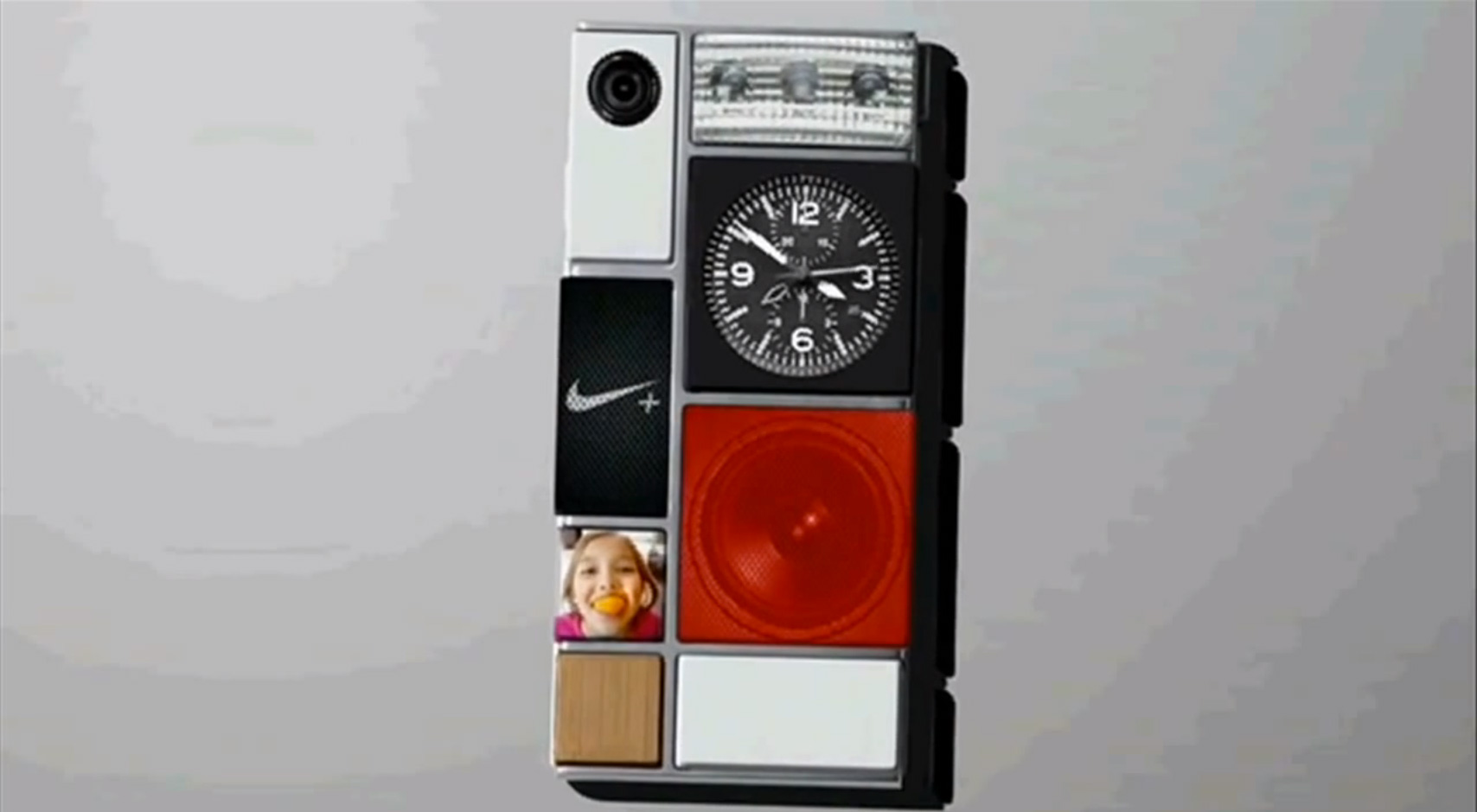
Project Ara. No.

You might suggest I stop reading tech news sites if I have so many problems with them. The truth is, that’s where most of the tech scoops happen, so I keep reading them. This doesn’t mean I’ll stop calling bullshit on them when they post stupid headlines, like this one from BGR.com:

Watch Google show off the craziest experimental smartphone we’ve ever seen

After watching the YouTube video of Google’s demonstration of the first “working” Project Ara device, I couldn’t help but laugh.

First off, the audience of Android nerds OOHs and AHHHs when the demonstrator gets a very, very rough prototype device to merely boot up and show the Android logo. Really, guys?

Secondly, while the idea of a modular mobile computer sounds awesome, tell me exactly what person would customize a phone like you’re proposing:

This is the kind of phone the 15-year-old version of myself would have designed. A speaker! A clock! Yeah! Totally!

NO.

I think there’s a hobbyist market for such a device, but it’s nothing that would ever have mass appeal. It’s also a difference in philosophy from a company like Apple. Apple has very opinionated design in their products.

They build devices and user experiences based on what they feel is best. Your ability to customize such experiences is severely limited (although this is changing a bit with iOS 7 customizations).

Categories:

Technology

Tags:

Weekly Exhaust Ep. 6: We Were In College, We Didn’t Care About Facts

This week Michael and Bryan discuss Vanna White, Yul Brynner as a robot, how HDR imaging is abused, the misconception that mobile apps are easy to make, Bryan’s fear of flying, the grit of Philadelphia and growing up in the suburbs.
This episode opens with the exhaust from a 1968 Camaro Super Sport.
Weekly Exhaust, Episode 6
If you’re interested in sponsoring the podcast, contact Michael.

Categories:

Podcast

Tags: