For Those
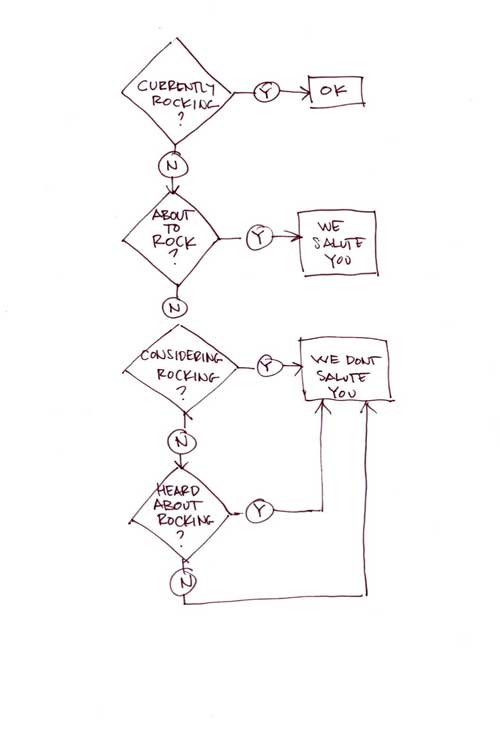
via Suicide Cat
via Suicide Cat
I don’t listen to music when I’m working on the computer – unless it’s mindless production work where my brain doesn’t require intense concentration. If I’m listening to anything, it’s usually something ambient or neutral (like brown noise, or sounds from nature). I like it quiet when I’m working creatively.
The same is true for for visual noise. I (try to) keep my computer and actual desktops clear of shit.
But even if my computer desktop is clean, I still have to deal with application windows stacked on top of application windows …stacked on top of application windows. It looks noisy. Messy.
Thanks to my friend Ryan, I’ve now solved this problem with Spirited Away.
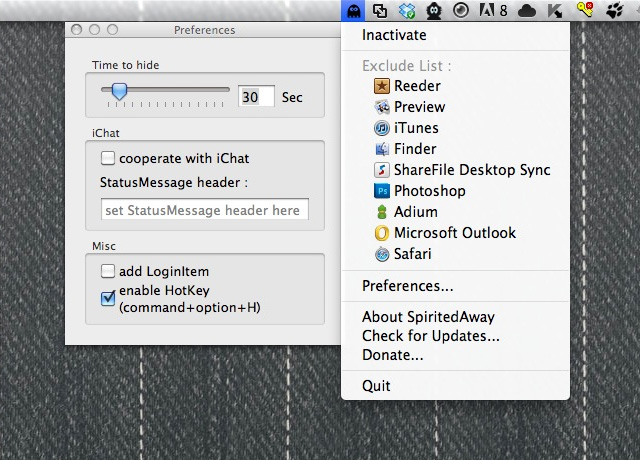
Spirited Away is an invisible program that runs in the background and listens for inactive programs. When you haven’t used a program for a certain period of time, it hides it.
I’ve only been using it for a few hours now, but I love it.
Perhaps this also a side effect of using an iPad and an iPhone more and more. I’m getting accustomed to only seeing one program at a time. Multi-tasking is great when you have focus. And Spirited Away helps me get back some focus.
Some people might say it’s simply a matter of quitting out of programs you’re not using, but I’ve found that by simply not seeing the program, it’s almost the same as them not running. It also saves me the time of relaunching them.
Spirited Away is free, but I donated to the developers. I like supporting independent developers producing smart work.
Via my wife. Pretty incredible film and campaign.
See also Invisible Children
Update: There’s an interesting counter-point over at the Atlantic on Why We Should Take Heart From the Backlash Against Kony2012.
Farhad Manjoo on the unbeatable iPad:
Imagine you run a large technology company not named Apple. Let’s say you’re Steve Ballmer, Michael Dell, Meg Whitman, Larry Page, or Intel’s Paul Otellini. How are you feeling today, a day after Apple CEO Tim Cook unveiled the new iPad? Are you discounting the device as just an incremental improvement, the same shiny tablet with a better screen and faster cellular access? Or is it possible you had trouble sleeping last night? Did you toss and turn, worrying that Apple’s new device represents a potential knockout punch, a move that will cement its place as the undisputed leader of the biggest, most disruptive new tech market since the advent of the Web browser? Maybe your last few hours have been even worse than that. Perhaps you’re now paralyzed with confusion, fearful that you might be completely boxed in by the iPad–that there seems no good way to beat it.
I love Apple, but it seems likely my weariness from writing only about Apple might continue for a while.
John Gertner for the NYTimes on Bell Labs:
So how can we explain how one relatively small group of scientists and engineers, working at Bell Labs in New Jersey over a relatively short span of time, came out with such an astonishing cluster of new technologies and ideas? They invented the future, which is what we now happen to call the present. And it was not by chance or serendipity. They knew something. But what?
The guy who was responsible for creating the creative culture was Mervin Kelly.
How did he do it?
One element of his approach was architectural. He personally helped design a building in Murray Hill, N.J., opened in 1941, where everyone would interact with one another. Some of the hallways in the building were designed to be so long that to look down their length was to see the end disappear at a vanishing point. Traveling the hall’s length without encountering a number of acquaintances, problems, diversions and ideas was almost impossible. A physicist on his way to lunch in the cafeteria was like a magnet rolling past iron filings.
Sounds like another building from an institution known for creativity and innovation, the original MIT Media Lab building (via):
The Lab, which has its origins in architecture (the founder of the Media Lab, Nicholas Negroponte, is an architect) draws upon the tradition of studio design critique; we have daily visits from our industry partners and other practitioners with whom we engage in an authentic critical dialogue about the work. In this exchange, the work is discussed within a broader context — ideas (and prototypes) are exchanged, improvements and alternatives suggested. We then advance to the third phase of the innovation cycle — iterate. Iteration within the Lab means returning to ‘Step One’ to push our ideas further. Iteration within our partners’ organisations means taking a prototype towards real-world application. In both cases, we can learn from our mistakes (and successes).
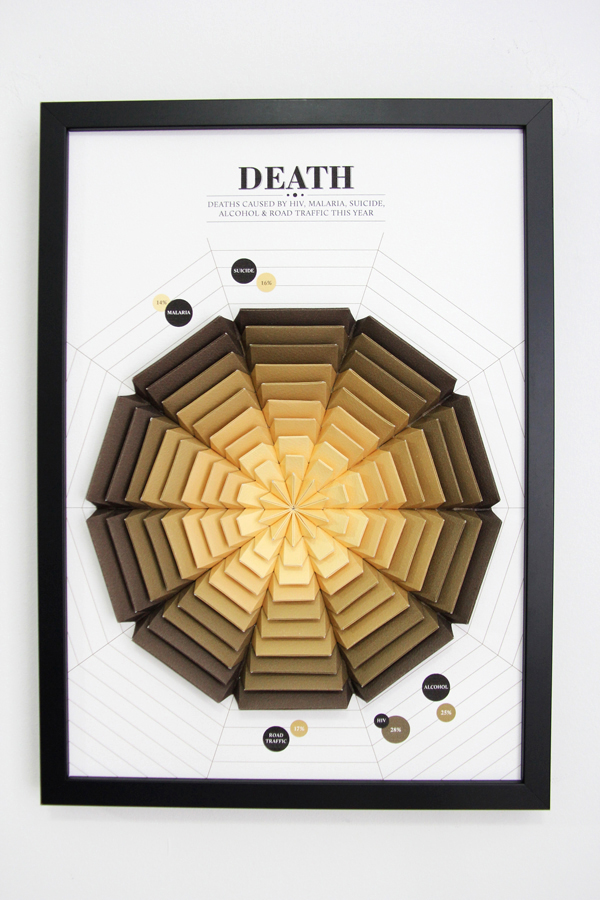
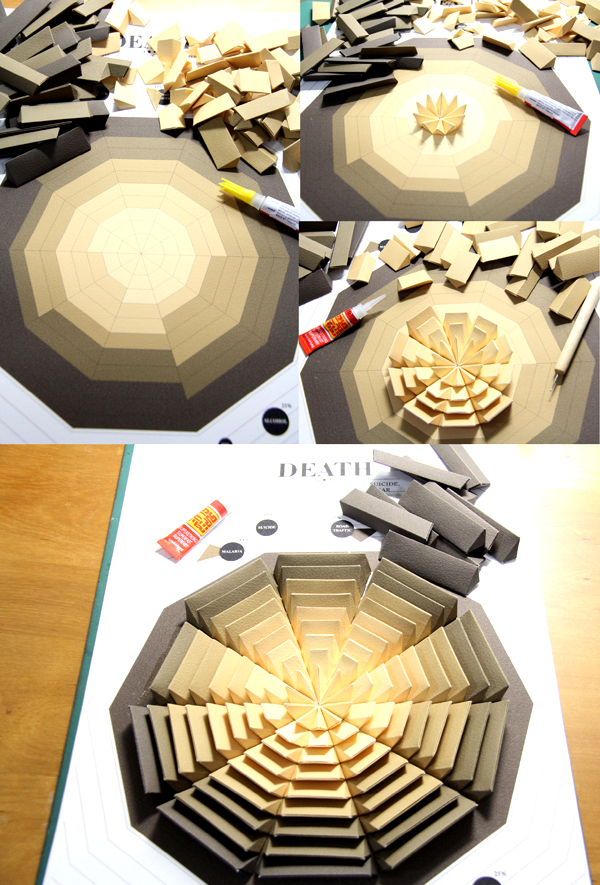
Pretty awesome 3-D dataviz posters by Pattern Matters (via Colossal)
Beth Jinks reporting for Bloomberg on Watson’s new Wall Street job:
International Business Machines Corp. (IBM)’s Watson computer, which beat champions of the quiz show “Jeopardy!” a year ago, will soon be advising Wall Street on risks, portfolios and clients.
Citigroup Inc. (C), the third-largest U.S. lender, is Watson’s first financial services client, IBM said yesterday. It will help analyze customer needs and process financial, economic and client data to advance and personalize digital banking.

Beautiful photography by Naz Hamid (via Wilson Miner)
Looks like there’s a good amount of exhaust on Pinterest.
Update: Okay, I just realized some of those pins are actually mine.
Ars Technica: Legendary Star Wars concept artist Ralph McQuarrie passes away at 82
What makes McQuarrie’s artwork resonate so much isn’t just that it’s beautifully executed, but that the art direction of actually Star Wars movies is so consistent with it.
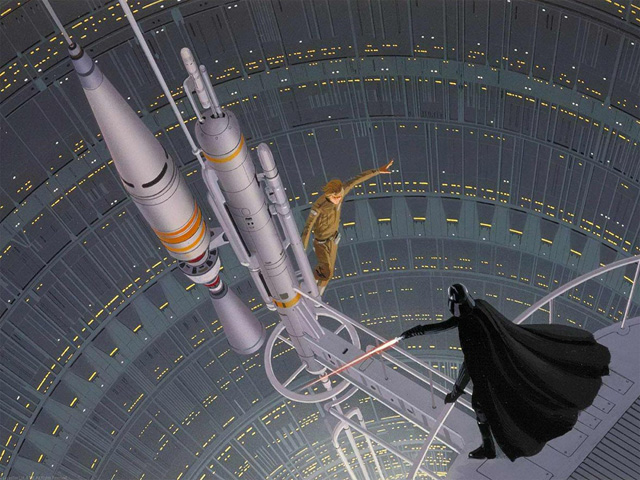
image via concept ships (via Daring Fireball)
Such bullshit. I never react like that.
Over at McSweeney’s, Joshua Tyree on the Implausibility of the Death Star’s Trash Compactor:
5. And what of the creature that lives in the trash compactor? Presumably, the creature survives because the moving walls do not extend all the way to the floor of the room, where the liquid is. After all, if the walls reached the floor, the creature would be killed each time trash is compacted. The design employed on the Death Star must allow the organic trash to filter down to the bottom, where the parasitic worm-creature devours it. But what happens when heavier pieces of non-organic trash fall down there? Would such trash not get wedged under the doors, causing them to malfunction? Do stormtroopers have to confront the creature each time they retrieve pieces of un-compacted trash?
All valid questions.