Best Intentions

We may now have a new “most unread best seller of all time.”

Data from Amazon Kindles suggests that that honor may go to Thomas Piketty’s “Capital in the Twenty-First Century,” which reached No. 1 on the best-seller list this year. Jordan Ellenberg, a professor of mathematics at the University of Wisconsin, Madison, wrote in The Wall Street Journal that Piketty’s book seems to eclipse its rivals in losing readers: All five of the passages that readers on Kindle have highlighted most are in the first 26 pages of a tome that runs 685 pages.

The rush to purchase Piketty’s book suggested that Americans must have wanted to understand inequality. The apparent rush to put it down suggests that, well, we’re human.

—Nicholas Kristof, An Idiot’s Guide to Inequality

I’m guilty of going a step farther: I acquire tons of e-books with the intention of reading them, but takes years for me to get around to reading them (if ever).

Categories:

Literature

Tags:

 /  / 

There’s an idea in this pile of cash somewhere.

Awesome headline: BGR: Samsung is ‘hiring like crazy’ trying to come up with original ideas

Samsung is spending somewhere in the neighborhood of $300 million in building its Bay Area R&D center, which will be an enormous facility of 1.1 million square feet. Business Insider notes that Samsung actually spent more on R&D than any other company in the world last year, although the Korean smartphone still isn’t seen as an innovation powerhouse like Apple and Google are.
I’m confused. Does throwing money at technology not make it more innovative?

Categories:

Innovation

Tags:

Being too close to a project

It sure seems like Amazon, and really, every company could benefit from some sort of Vice President of Devil’s Advocacy. That is, someone who looks at a product just about to launch and points out all the reasons it will fail.

It was said the Steve Jobs served a similar role throughout his years at Apple. He’d be presented with a product and more often than not, he’d rip it apart. He was even known to cancel launches at the last minute if he didn’t feel like something was up to snuff.

But Jobs was also undoubtedly deeply involved in the creation of these products. He was the rare visionary who could step back and see the forest through the trees. (And even he had missteps –plenty of them.)
—MG Siegler, The VP of Devil’s Advocacy

Categories:

Business

Tags:

“To play, you must seek information elsewhere.”

Minecraft-the-game, maintained in Sweden by Persson’s small studio, is just the seed, or maybe the soil. The true Minecraft (no italics, for we are speaking of something larger now) is the game plus the sprawling network of tutorials, wikis, galleries, videos–seriously, search for “minecraft” on YouTube and be amazed–mods, forum threads, and more. The true Minecraft is the oral tradition: secrets and rumors shared in chat rooms, across cafeteria tables, between block-faced players inside the game itself.

The true Minecraft is the books.
—Robin Sloan, The secret of Minecraft
If I ever get to point where I have more disposable time on my hands, I’m going to play Minecraft.

Categories:

Games

Tags:

PHHHOTO

If you’ve been to big events or company parties lately, you might have taken animated-GIF shots in a PHHHOTO booth.
Well, it’s not so much a booth as it is an iPad on a tripod with a circular, photography light around it. Once you take your GIF, you can choose to have it texted to someone. The party my company had earlier this year had the GIFs on rotation and projected on the wall of the gallery we rented.
PHHHOTO is the brainchild of HYPERHYPER, an experimental design/software studio in LA & NY. One of the co-founders is actually an old friend of mine from high school and my former East Village roommate, Russell Armand.
A few days ago, HYPERHYPER released a free, PHHHOTO iPhone app and the best way to describe it is Instagram for animated GIFs. When you choose to take a picture, it takes a burst of 5 photos. From there you only have the filter options of color or black and white. Nice and simple. Like Instagram, you can follow other people and there’s also a count of the number of PHHHOTO parties you’ve been to (you can book an event at phhhoto.com/pro).
Try it out, it’s a lot of fun (I’m combustion on PHHHOTO).


Categories:

Product

Tags:

Amazon Fireless Phone

Walt Mossberg gets right to the point in his review of Amazon’s Fire Phone:

But I consider the Amazon Fire phone no more than an interesting first step. In my tests, I found its big new features less useful than I expected, and sometimes outright frustrating. And, arriving seven years after the debut of the first modern smartphone, Amazon’s new entry lacks some key functions both Apple and Samsung include.
But over at the NYTimes.com, Farhad Manjoo is more bullshitty:
Amazon’s focus on the Fire Phone’s flashier side is unfortunate, because when I dug beneath the gimmicks, I found something better than 3-D heroics. The Fire Phone is uncommonly friendly and easy to use. As a bare-bones smartphone, it should prove especially attractive to people who find themselves overwhelmed by today’s crop of do-it-all superphones. When you forget about its whiz-bang marketing, the Fire begins to stand out as something much more interesting: a phone for the rest of us.
Uncommonly friendly? How so? And what is a “do-it-all superphone”? Is he referring to Android phones? iPhones? Without specific comparisons, none of this means much.
Later on, Manjoo on the “carousel” feature:
But what the Fire Phone lacks in aesthetics and breadth of capabilities, it makes up for in ease of use. Consider the phone’s main app-launching interface, the “carousel,” which should be familiar to people who’ve used Amazon’s Kindle Fire tablets. The interface constantly sorts your apps according to how recently you’ve used them. This let me navigate my phone very efficiently, often saving me from getting lost in a sea of apps — a common occurrence on most other phones.
Call me crazy, but I do this thing where I put all my essential apps I use on a daily basis on my first home screen. On my second screen, I have lesser-used apps organized in folders by function: Look, Listen, Read, Socialize, Buy, Pay, Travel, Create and Play. If you’re getting lost in a sea of apps on your phone or tablet, maybe you’re the problem, not your device, Mister Manjoo.
All in all, I get the impression the Amazon Fire Phone is not a great phone.


Categories:

Technology

Tags:

You Are Not A Storyteller

Stefan Sagmeister is an incredible designer, and I agree with what he says in the video below to an extent.
I think many designers mistake articulation with storytelling. They’re not the same. Designers and art directors and creative directors need to be able to sell ideas to clients. Doing this involves articulating in words what they and their team made with typography, shape, color and motion.
Articulation of ideas is a integral skill all designers should learn.
But it’s not storytelling.
I think the equation is: All stories are articulations, but not all articulations are stories.

Categories:

Technology

Tags:

Tip of the Day: How to Kern

Yesterday I gave away my kerning secret on Twitter and it seemed to resonant with a few people so I thought I’d share it here.
(if you had a proper graphic design education, this isn’t a secret)
How to kern a word:
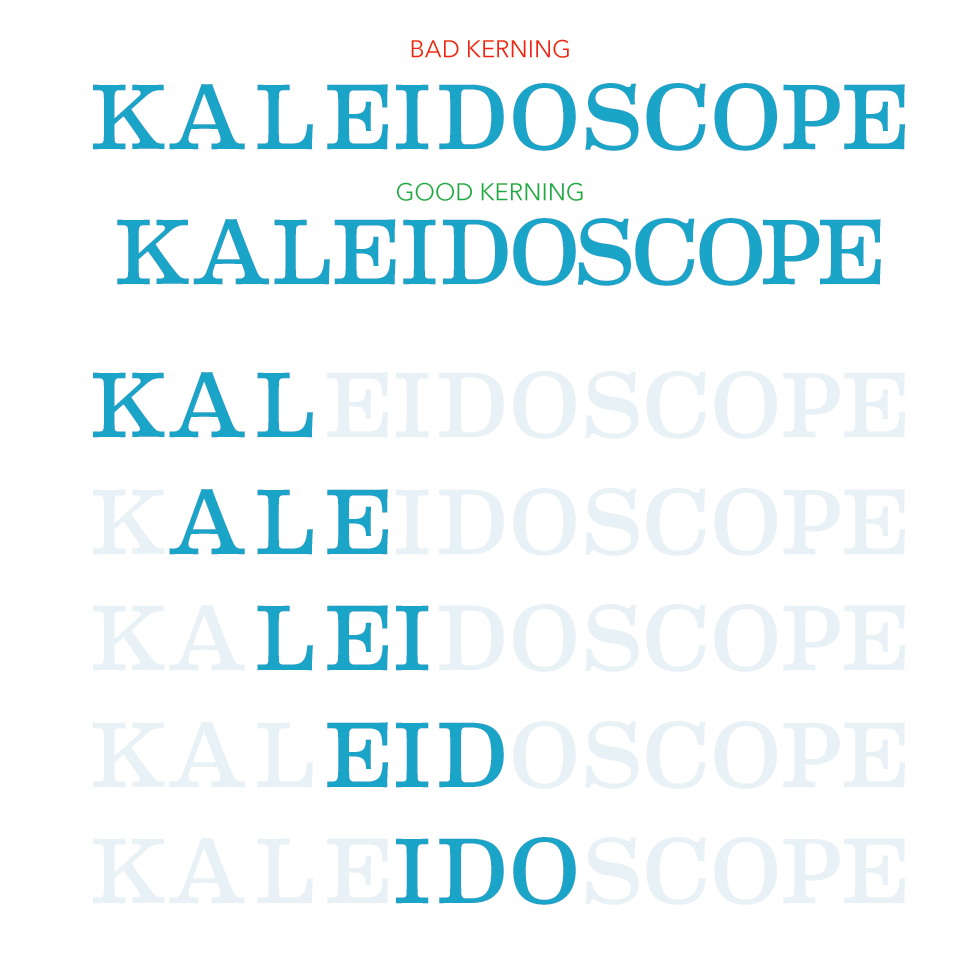
1) From the beginning of the word, look at the first three letters; cover the remaining letters if needed (as you become a kerning Jedi, you won’t need the blinders)
2) Do these first three letters look evenly spaced from each other? If not, expand or contract the spacing between the letter (s) in question
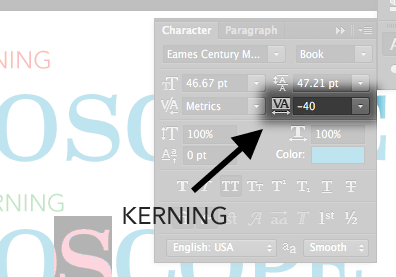
The controls in Photoshop, Illustrator and InDesign are very similar:

3) Now move to the next letter to the right and the 2 letters following it. Repeat Step 2.
4) Continue this process until you finish kerning the word
Bonus tip: Round letters like ‘O’ and ‘B’ need the letters next to them more tightly kerned on the side(s) with round edges. This is to compensate for the illusion that letters with rounded edges are farther away than letters with flat/perpendicular edges.

Categories:

Typography

Tags:

Mo’ Data, Mo’ Problems

Om Malik on Big Data:

Facebook’s emotion-driven-engagement experiments are tiny glimpse of what really awaits us: a data-driven and alogrithmic future, where machines make decisions on our behalf, nudging us into making decisions. As I pointed out in my recent FastCompany magazine column, the new machine age is already underway, unseen by us. “It is not really just a human world,” said Sean Gourley, cofounder and CTO of Quid who points out that our connected world is producing so much data that it is beyond human cognitive abilities and machines are going to be part of making sense of it all. So the real question is what will we do and what should we — the technology industry and we the people do? From my perspective, we need to start with the raw material of this algorithmic future: data. Whether it is a billions of photos that carry a payload of emotions, relationships and location data, or status updates announcing the arrival of a new one or those searches for discount Prada shoes or a look-up about a medical condition — there is someone somewhere vacuuming our data droppings and turning them into fodder for their money machine.
And:
Automation of our society is going to cause displacement, no different than mechanization of our society in the past. There were no protections then, but hopefully a century later we should be smarter about dealing with pending change. People look at Uber and the issues around it as specific to a single company. It is not true — drones, driverless cars, dynamic pricing of vital services, privatization of vital civic services are all part of the change driven by automation, and computer driven efficiencies. Just as computers made corporations efficient — euphemism for employed fewer people and made more money — our society is getting more “efficient,” thanks to the machines.
We live in a post now, ask questions later world.

Categories:

Community

Tags: