Of Course They Do

BGR: Even Android users want iPads instead of Android tablets

The iPad was a top Black Friday seller, even among Android users. According to a report by InfoScout, about 40% of Black Friday iPad purchases were by Android users. These numbers are certainly good news for Apple. They suggest that Android users are not particularly loyal to their platform and are willing to try out iOS, at least on the tablet. While Amazon, Microsoft and Google tout their tablets, the iPad continues to be the most used device by a long shot, with 84.3% usage.
None of the reports about the discrepancy between Android devices sold and Android devices used surprise me based on what I see in the “real” world. Every time I travel, I always see a majority of iPads and iPhones to a minority of Android tablets and phones.
I’ll admit to seeing more Samsung Galaxy phones than I used to, but the Android tablets must be hiding, because I don’t see them.

Categories:

Technology

Tags:

Bookness

David Streitfeld at the NYTimes on e-books keeping the conventions of their print ancestors:

Some functions of physical books that seem to have no digital place are nevertheless being retained. An author’s autograph on a cherished title looked as if it would become a relic. But Apple just applied for a patent to embed autographs in electronic titles. Publishers still commission covers for e-books even though their function — to catch the roving eye in a crowded store — no longer exists.

What makes all this activity particularly striking is what is not happening. Some features may be getting a second life online, but efforts to reimagine the core experience of the book have stumbled. Dozens of publishing start-ups tried harnessing social reading apps or multimedia, but few caught on.
Early television imitated radio when it first came out and the first automobiles imitated the conventions of horse carriages (the word ‘car’ is short for ‘carriage’).
Give it some time, e-books will find their voice too.

Categories:

Materials

Tags:

There’s No “I” In “Team”

Excerpt from “Jony Ive: The Genius Behind Apple’s Greatest Products“:

Over in IDg, Jony began, as usual, with the iPhone’s story. As he later explained, it was all about how the user would feel about the device. “When we are at these early stages in design, when we’re trying to establish some of the primary goals–often we’ll talk about the story for the product–we’re talking about perception. We’re talking about how you feel about the product, not in a physical sense, but in a perceptual sense.”
Ive is an interesting guy, but I have a problem with the book’s title. I would modify it: “Jony Ive: One of the Geniuses Behind Apple’s Greatest Products”.
Design is a collaborative process and as noted in the book, Ive was part a rockstar team of designers and engineers. This doesn’t negate Ive’s genius, it’s simply a more accurate description of the reality that exists in the world of design.
Think of Jimmy Page. He’s one of the most talented guitarists that ever lived, but the magic he created in Led Zeppelin was through his collaboration with John Bonham, Robert Plant and John Paul Jones.
The lone genius is capable of amazing feats, but get a group of brilliant people together and who knows what’s possible. The sky’s the limit.

Categories:

Process

Tags:

A Simulation Built Just for Us

Daily Exhaust Mike sent me this article the other day, entitled Do We Live in the Matrix? It details an interesting concept, one that has been bouncing around the halls of academia in the 21st century: do we actually exist inside of a computer simulation? The idea is a little different than the Matrix of movie fame. In that, real life humans are being fooled into believing their simulated experiences are real, while their bodies are in fact being held in stasis.
The idea that some philosophers, astrophysicists, and computer engineers have come up with in the past decade is not that our senses are being tricked into experiencing a reality other than truth, but that our bodies and our minds are part of the simulation. Not only is the world we experience not real, we ourselves are not real, nothing more than sprites, mobs, or NPCs walking around a simulated universe. As computer processors become more powerful, and as programs become more complicated, it’s not that far of a stretch to think that someday we will be able to develop a computer simulation that is detailed enough that, from the perspective of the simulation, has little difference from the real universe. That being the case, since simulations can be run over and over again, on multiple machines, it becomes not only a possibility that we ourselves are living in a simulation developed by another race…it becomes likely.
The article pokes a bit of a hole in the idea of a perfect simulation. It cites the work of Seth Lloyd from MIT, who posits that developing a perfect simulation would require so many calculations that there isn’t enough energy in the universe to run it. Case closed, right? Not so fast.
The article goes on to state that the simulation does not need to be perfect. It only needs to be perfect enough to fool the simulated beings living within the simulation. That is, us. As long as we don’t look too closely at the universe around us, and see where the Mystical Programmer (God?) decided to optimize, there is no way we could know for sure. A programmer skillful enough could fill the night sky with tiny points of light, but only when Galileo looked through a telescope at Jupiter or Saturn need the details be filled in somewhat. The moon only needed to be a very large and bright two-dimensional disc in the sky, covered with superficial surface details, until we decided to send people to walk on it.
To me, this is mildly disturbing. I have no problem living in a simulated universe as long as the simulation simulates everything. As long as there is no optimization, then, from our perspective, the universe does become real. But a universe with optimization has a purpose, and that purpose would seem to be to fool us. That’s a very teleological way to regard the universe, and not typical of academics, who tend to have a less homocentric view of the cosmos. That’s why I’m leaning towards the idea that the universe we experience is real.
Why run a simulation that only approximates the parts of the universe that sprites within that universe are experiencing? If that is the case, then the subject of study in the simulation is not the universe, but the sprites. It would be nice, I guess, to think we had that kind of importance in the simulation, but it only serves to rescue us from the evidence that suggests we are very small, very mortal, parts of a universe that is bigger than human comprehension.
The idea of a simulated universe, and how to theoretically accomplish said simulation, moved seamlessly to the idea of creating a simulation that responds to observations of sprites within the simulation, i.e., us. Evolutionary theory posits that such an egocentric view is an unavoidable result of how our brains evolved, so until the Mystical Programmer deigns to make its presence known, I’m going to continue to assume that any random point of light I see in the night sky is a fiery ball of nuclear fusion blazing away at some unimaginable distance, not an elaborate hoax perpetrated for our benefit.

Categories:

Philosophy

Tags:

Smelling Cancer

Woah:

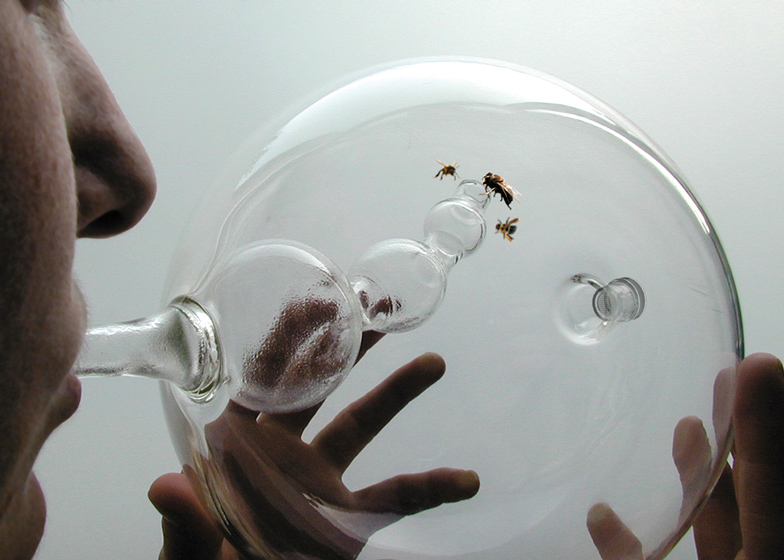
Designer Susana Soares has developed an astounding new tool that allows your average honeybee to detect early traces of cancer and other diseases by simply smelling your breath.

This technology relies on the honey bee’s acute sense of smell. The insects get trained to associate sugar water with a specific disease odor. When a subject breathes into the device, if the bees smell the odor they fly towards the glass feeding chamber indicating traces of the sickness. A bee can be trained to do this in just 10 minutes!
Dezeen_Susana_Soares_Bees_Design_SS_2.jpg

Categories:

Health

Tags:

A Blue Box

CSS-Tricks:

A little meme went around CodePen the other night. A Blue Box. I’m not sure how it started, but lots of people started posting code of different ways to draw a blue box. It’s weird, it’s funny, but it’s also rather amazing there is as many ways as there are for doing something so simple.
This is a great example of how to train you to think different.
To think outside the [blue] box, if you will.
If lateral thinking is your bag, I recommend reading Edward de Bono.

Categories:

Education

Tags:

You Got It Backwards

Over at the Guardian, Liz Bury wrote an article about a survey finding 62% of 16 to 24-year-olds prefer traditional books over their digital equivalents.
I was instant messaging with DE contributor Bryan Larrick about this and he made a great point: the real story is that 38% of young adults prefer e-books. The Guardian has the headline backwards.
Bryan had more exhaust: “So in about 10 years, e-books have eroded the print market to the point that 38% of teens prefer them? That is a massive disruption that hasn’t been seen, ever.”
We used to call Blackberries and Palm Treos, ‘smartphones’. Now? Not so much.
What we call ‘e-books’ today will be different years from now and so too will peoples’ preferences for or against them.

Categories:

Technology

Tags:

Coffee Is For Closers

Bloomberg: Apple Defeats Patent Claim Over Invention of Smartphone:

Apple Inc., the world’s most valuable technology company, was found by a federal jury not to infringe the patent of a 70-year-old electrical engineer who claims he came up with the idea for the smartphone.
The whole patent system is screwed up, and this is just one example.
Conversely, Apple (and Samsung and Dell and many other tech companies) is also guilty of getting lawsuit happy on very vague to very specific patents over things they’ve made, like Apple’s Slide To Unlock patent which was invalidated in Germany earlier this year.
I came up with ideas for a lot of shit when I was a kid, but I never made any of them. Doesn’t mean I should collect money for them.

Categories:

Law

Tags: