I can’t deal
Palm chief: no new Treos until summer – Bummer, I was looking forward to some fresh 8-bit graphic ‘smart’ phones.
…pysche!
Palm chief: no new Treos until summer – Bummer, I was looking forward to some fresh 8-bit graphic ‘smart’ phones.
…pysche!
Color Chart: Reinventing Color from 1950 to Today – Great data visualizing and navigation. (via swissmiss)
Publicis & Hal Riney – It’s not perfect by any means, but really makes me think of the possibilities… (via theFWA)
Microsites = waste – very good read.
And while we’re on the topic of bad practices on the web, check out, Think Different: Maybe the Web’s Not a Place to Stick Your Ads (via Design View)
Digital A-List 2008: Next in Line – #2 …Go Schematic!
UPDATE: I just realized we were also Webpick of the Week at CommArts for 02.29.08.
full disclosure: I’m an art director at this kick-ass agency.
I shoot photography because I love it. I think if I wasn’t an art director, my second career choice would be photographer.
Like any activity, photography takes practice. Many of my shots are not winners. That’s not to say that I snap away recklessly and hope for the best, but there’s definitely a level of experimentation I engage in.
A good part about this experimentation is due to the fact that for a while now, I shoot a lot of photos with my camera hanging around neck at around stomach-level. This lets me grab shots of people relaxed.
Many people are much more on guard when you’re aiming at them. Much like aiming a weapon, aiming a camera at someone without permission is threatening. With the camera at ease, I don’t have to worry about this. I get the shots I want. Well, I try my best to get the shots I think I’m getting from my waist.
Shooting like this sometimes results in some unexpected money shots, but many times they end up less-than-ideal. Underexposed, overexposed, out of focus.
Every now and then though, when the rare elements of photography are in alignment, I capture some great little moments. It makes all those duds worth it.

In the Ray, from the set 3.15.2008
Google Exec: Android Will Outsell iPhone
Is he sure? I’m not …and I wanted to burn this into database memory that someone at Google uttered these words.
Of course there’s a chance this could come to pass, especially considering it will/could show up on devices from Motorola, HTC, Samsung, and others.
Questions that have yet to be answered are:
Will all phones from Motorola, HTC, Samsung and others be using the Android OS?
How well will Android operate on the range of phones out there – from basic models to feature rich smart phones with QWERTY keyboards?
The reason Apple’s products work so well it because of the complete synchronization of hardware AND software. There’s a lot of benefits to a controlled environment.
Developers are bitching and moaning about how the iPhone can only run 1 program at a time – none can run in the ‘background’. I encourage these clowns to develop their own applications, jailbreak their iPhones and see how well their iPhone runs when they have disregarded the technical specs on memory and CPU.
There’s a chance Apple might know a little bit about performance optimization. Just a chance.
With Android, there isn’t a well-designed SDK and GUI to develop, test and troubleshoot applications with, so I can’t foresee it integrating seamlessly across the board on all the various phones it could end up on.
Call me crazy.
After yesterday’s post on the great ad-blocking Firefox plug-in, AdBlock, I kept thinking about advertising.
We’ll always have advertising in one form or another. To get interpretive for a moment, we all engage in advertising, when we get dressed to go on a date, or an interview – you’re selling yourself.
Anyway, I was thinking about how banner ads on websites suck so bad and I realized something that is very comparable – Green Peace sidewalk solicitors.
If you live in a big city like New York you know who these people are. I’ve even seen them outside large department stores in suburbs throughout the country.
The reason banner ads are like Green Peace solicitors is because both of them distract you from your objective. Many of you are conditioned to block out both of these distractions and continue on with your objective, but regardless if you do or don’t have this ability, they’re annoying as hell.
We’re already seeing advertising changing from distractions, to destinations – advertising experiences that people choose to view.
I’ll leave this idea for another post.
A zoom-in on one of the jellybean status icons from iChat:

Zoom-in on the sound visualizer in iTunes:

The other day I was trying to imagine an online world with no advertising. No advertising meaning, no Adobe Flash ads, no banner ads, no Eyeblaster roadblocks and no ad pages that pop up before I get to the page I clicked for.
Then I thought – couldn’t you write an add-on for Firefox that removes ads?
Turns out, such a thing already exists – has existed since 2006. I know, I’m late on this.
Is called AdBlock and has changed my online viewing experience completely allowed me to enjoy online content more. I think it also shows not only how ugly ads are to the online landscape. but also how outdated the current ad models are.
I don’t click on banner ads, but now I don’t have to deal with the noise that ads create on websites I visit.
In cheesy infomercial style, I’d just like to say,
“Thank you AdBlock – you’ve changed my life!”
How awesome is AdBlock? Look below for the below-and-after shots of some websites I frequent (note that none of these images have been edited in Photoshop):
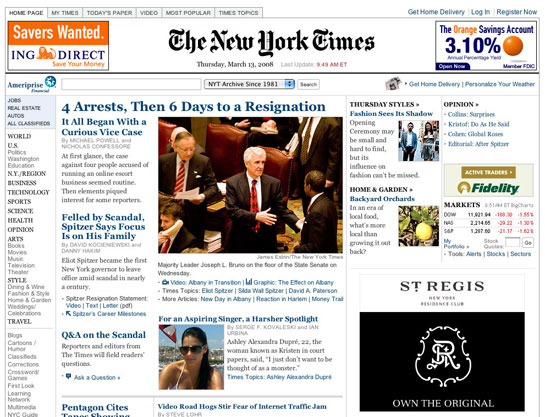
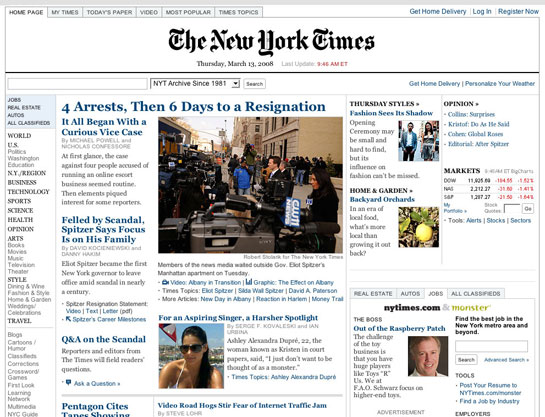


Full disclosure: I am an Apple shareholder, and have been using Apple computers for over 10 years. Microsoft can take it deep.
I’d like to squash all these false statements about how Apple ‘fanboys’ gloat over their precious iPhones.
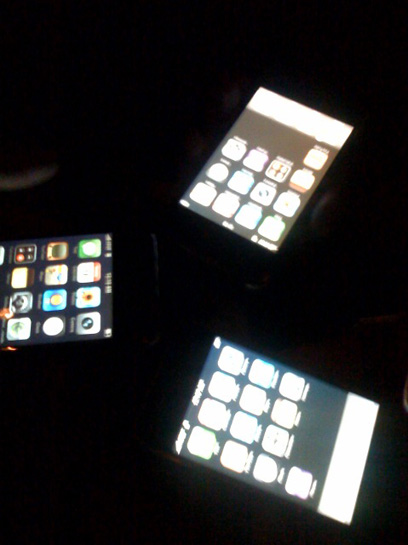
I was out this weekend with some friends and friends-of-friends. They all had iPhones, and the interesting thing was – they were all PC users. Below is a shot I took with my iPhone of the other three.
I have to tell you, PC users seem to gloat just as much over their iPhones as Mac users do. So be sure you know who you’re talking about next time you want to hate on a Mac user, he just might be one of your own!
Stay vigilant.
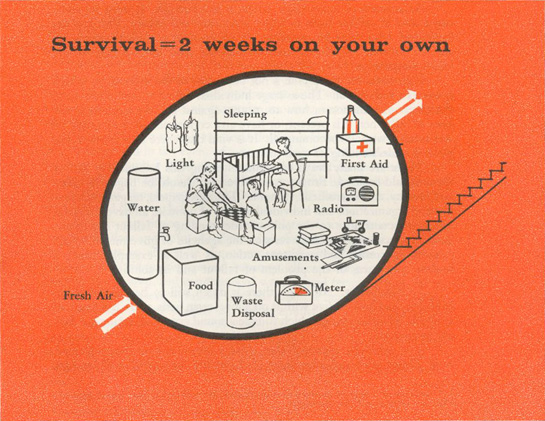
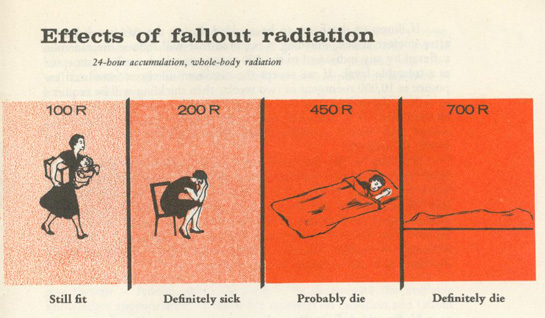
I was at the flea market on 25th & 6th Ave last weekend, looking for graphic gems and I found a few. One item I found was Protection from Radioactive Fallout. It was published in 1959 and the gist of it is that if a nuclear bomb drops, you’re fucked no matter how way you slice it.
Here are the more interesting illustrations:


Great effects reel from Sea Level (thanks Jory)
I came across this article in my Google Reader: DVD format battle attracts a new rival: HD VMD
I have to point out some things regarding the whole battle warfeud competition between DVD DVD and Blu Ray …and now possibly HD VMD – this is going to confuse the shit of out consumers.
When manufacturers constantly update their hardware formats, they’re unintentionally causing buying anxiety in consumers. We’re at a point now where a lot of people have finally gotten around to buying a DVD player, and some have even gone as far as to start their own collection – whether this collection be purchased or ripped from Netflix DVD’s.
In 2007 two new formats emerged with more resolution muscle and capacity and we were told to scrap the DVD format, go with one of these new formats – although we weren’t sure yet what the adoption/endorsement from major studios was going to be yet on either format (now that we’re into March of 2008 it seems Blu Ray is the ‘winner’).
Then this morning I read about this new HD VMD format.
Enough is enough.
What happens in situations like these are what Barry Schwartz calls the Paradox of Choice. Basically, if people are presented too many options, or in this case, asked to change video formats too quickly, instead of picking one – they don’t pick any.
Contrast the problems of hardware upgrades to software upgrades. Let’s use my favorite new device – my iPhone.
The iPhone updates (and OS X updates in general) happen without the need to replace anything due to their nature (it’s called SOFTware for a reason, actually, it’s technically called firmware).
The whole process is practically seemless – just download the software update, install, and reset/reboot. No additional hardware, memory, plug-ins or connectors.
We can see the benefits of such software-based systems with a simple and very likely scenario.
Say Apple suddenly decides it needs to update your iPhone with a new version of Quicktime with dozens of new features and functionality and will sport a Super Extra Ultra High Definition resolution. If the iPhone relied on hardware upgrading to make this happen there would be 3 possible outcomes:
1. You upgrade your iPhone hardware and everything goes smoothly
2. Apple makes you buy a new iPhone to enjoy the new features
3. You upgrade your iPhone hardware and everything goes horribly wrong
4. You do nothing, and keep your iPhone as is
Of course, we don’t have to worry about any of these possibilities since all we need to do is connect our iPhone to iTunes, sync it and restart it.
Google understands the power of this with Google Docs and all their other online tools. Google can change their software at will without affecting anyone’s computer. I won’t even get into the benefits of not having to launch software locally from your hard drive.
Technology systems reliant on a fixed format lack agility.
Umair over at Bubblegeneration has some more great thoughts on Why HD-DVD And Blu-Ray Are (Strategically) Obsolete.
The cover story in Wired right now is Free! Why $0.00 Is the Future of Business.
But free is not quite as simple — or as stupid — as it sounds. Just because products are free doesn’t mean that someone, somewhere, isn’t making huge gobs of money. Google is the prime example of this. The monetary benefits of craigslist are enormous as well, but they’re distributed among its tens of thousands of users rather than funneled straight to Craig Newmark Inc. To follow the money, you have to shift from a basic view of a market as a matching of two parties — buyers and sellers — to a broader sense of an ecosystem with many parties, only some of which exchange cash.
The most common of the economies built around free is the three-party system. Here a third party pays to participate in a market created by a free exchange between the first two parties. Sound complicated? You’re probably experiencing it right now. It’s the basis of virtually all media.
You have to read the story to have that title make sense to you.
…and I think The Beauty Of 99¢ iPhone Apps (via) shares a lot of the same thinking.