Friday Moment of Zen

via ffffound
via ffffound
via swissmiss
Kirby Ferguson is back with a new, one-off video, Everything is a Remix Case Study: The iPhone.
I love Kirby’s work, but this video isn’t as strong as his bigger Everything is a Remix Series.
In fact, his TED Talk on the subject of the iPhone was even better.
If you pitched the idea of a smartphone-controlled paper airplane to most business men and women, they’d laugh in your face.
Well, as I write this, the PowerUp 3.0 Kickstarter project is up to $601,875.
Fuck you, business people.
(Remember, most people like the result of creativity, not actual creativity itself.)
My friend and studiomate Rick Kitagawa is launching a 5-week course about entrepreneurship for artists this January in San Francisco. It’s called Artrepreneurship 101:
Forged from real-world experience, psychological and sociological studies and books, finance and marketing research, and the advice from people who are making a living off their art, Artrepreneurship 101 is a class designed to teach you how to deal with the emotional aspects of being a professional art hustler as well as the actual tactics and tricks I’ve used to make it as a professional artist. Artrepreneurship 101 is unique in that it goes beyond just telling you how to market and sell art – by using a combination of exercises and group work, we’ll also tackle things like self-doubt, procrastination, and other psychological barriers that impede you from getting your important work done.
Heed to lazy asses out there:
There will be hard work ahead, so if you are looking for “Quick and EZ,” then please, walk away now. I’m not going to promise you overnight success (no one is an overnight success, and if anyone promises you that, they’re lying to you), but I will promise you will leave with the tools, knowledge, and support you’ll need to kick-start a career in the arts.If you are willing to commit to yourself, work hard (on the things you love), and really chase after your dreams, get ready, because enrolling in this course will be the first step in your new life.
If you’re reading this and you live in the Bay Area, use the code “exhaust” to get $50 off the price of the course (good until Dec. 25).
If you’re curious what the hell makes Rick Kitagawa such a smartypants, he’s a sponsored artist for KRINK, Savoir-Faire, and Crescent and he runs his own screen printing company, The Lords of Print.
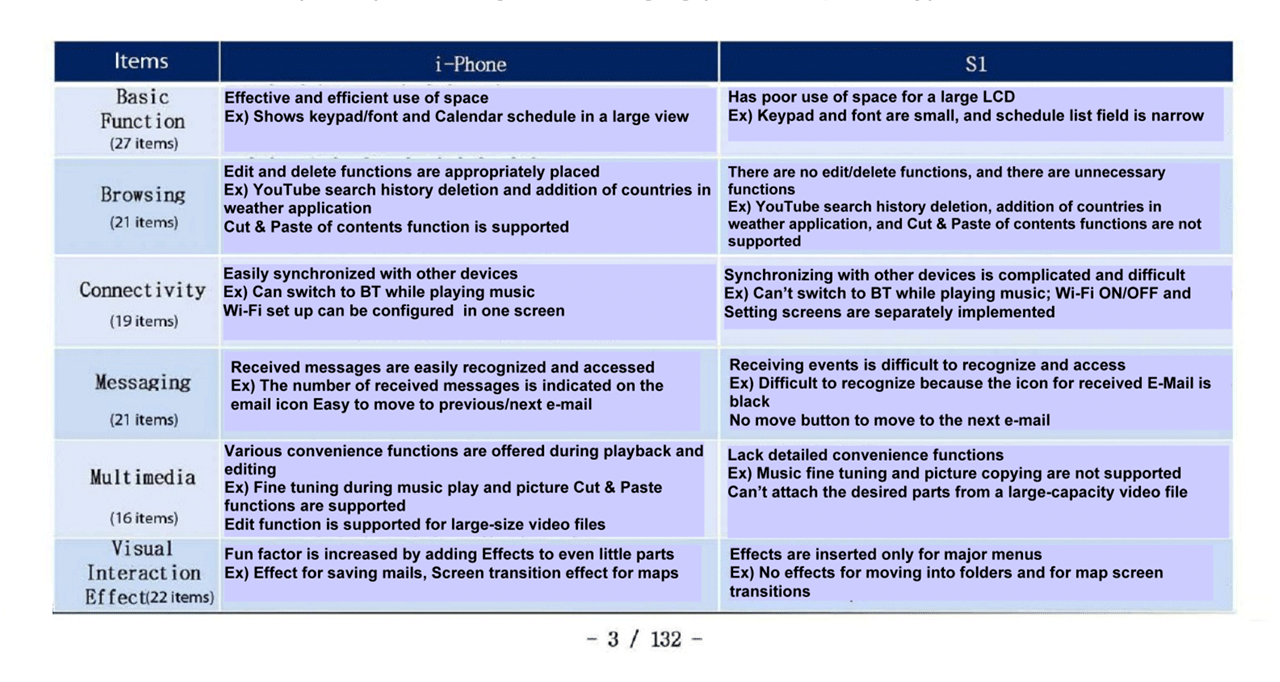
Taken from Samsung’s 132-page engineer’s guide to copying the iPhone.
Question: Wouldn’t it be more effective to give that document to Samsung’s designers? Does Samsung have designers?
Phillip Greenspun is not a fan of Samsung’s software (via BGR):
Having switched from an iPhone 4S to a Samsung Note 3, I am amazed almost every day at some of the user interface decisions made by Samsung. (Apple fans: please don’t post comments about how it wasn’t smart to switch; I needed the Note for a work project.) Today I installed an operating system upgrade and was hopeful that some of the most glaring problems had been fixed. Sadly, they hadn’t…
As BGR notes, we’re talking about Samsung. The company that put together a 132-page document to show their engineers how to copy the iPhone UI pixel-for-pixel.
On a related note, my father has a Samsung 3D Smart TV. The “Smart” denotes it can connect to Internet services like Facebook, YouTube and Netflix. I try using the on-screen menus and it’s god-awful. Transitions and animations are choppy, the visual design is cheesy—overall it’s a very bad experience (the actual picture quality of the TV is great).
Steffan Barry on the importance of bringing developers into the creative process early:
Developers. They’re logicians, mathematicians, forecasters and teachers all wrapped up in one kick-ass co-worker. They live, work and play on digital’s frontline, and are pivotal partners in the creative development process; partners that, if included early on, can greatly enhance your chances of creating and executing an idea that will be successful in the digital space.
If you’re a web/mobile/interactive designer and you don’t like or want to work with developers, you should find another profession. The same applies to developers.
Aside from those rare unicorns that can do everything, designers can’t do what developers do, and developers can’t do what designers do.
When we work together, it’s like Voltron forming. Amazing shit is possible.*
**I once saw a group of designers and developers form a blazing sword and slice another design agency office IN HALF. True story.*
—my friend’s kid’s response to her mom
Daily Exhaust contributor Jory Kruspe designed a new site for The Society of Graphic Designers of Canada (for Manoverboard).
If you dig it, go vote for it at AWWWards.
Fortune looks at the legacy (if you can call it that) that Steve Ballmer leaves on Microsoft.
My favorite part isn’t the bullshit ego stroking the article gives Ballmer.
No, my favorite part is Jean-Louis Gassée in the comments:
No mention whatsoever of Ballmer’s many misses: music, search, maps, phones, tablets, windows 8, king of browsers Internet Explorer dethroned by Google, social networks.
Whatever, those are just little details.
Nothing to see here.
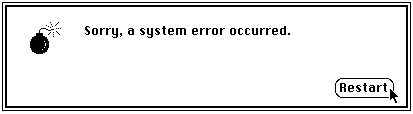
Over at Slate, Jessica Olien explains how people don’t actually like creativity:
In the United States we are raised to appreciate the accomplishments of inventors and thinkers–creative people whose ideas have transformed our world. We celebrate the famously imaginative, the greatest artists and innovators from Van Gogh to Steve Jobs. Viewing the world creatively is supposed to be an asset, even a virtue. Online job boards burst with ads recruiting “idea people” and “out of the box” thinkers. We are taught that our own creativity will be celebrated as well, and that if we have good ideas, we will succeed.
It’s all a lie. This is the thing about creativity that is rarely acknowledged: Most people don’t actually like it. Studies confirm what many creative people have suspected all along: People are biased against creative thinking, despite all of their insistence otherwise.
As Olien says in her post, part of creativity is uncertainty and people don’t like uncertainty.
I’d like to think as a web & mobile designer, my industry is the exception to this creativity bias, but it’s not. This is because designers might have the balls to try new, dangerous ideas, but clients don’t.
Clients want creative, but not too creative.